2010 Nobel Prize in Literature
Reason for Award
for his cartography of structures of power and his trenchant images of the individual's resistance, revolt, and defeat
Laureates
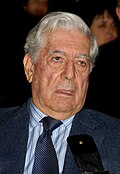
 Peru,
Peru,  Spain
Spain
Explanation
Mario Vargas Llosa writes stories that help people understand how society works. In his books he shows clearly where the “power” that moves a country or a town is located. He also paints vivid pictures of one person’s courage and frustration when facing that huge power. You can think of it like a classmate who tries to stop bullying even if the bully is stronger. The struggle may end in loss, but the will to try is what his stories teach us. These powerful tales touched readers everywhere, earning him the Nobel Prize in Literature.
Related Keywords
structures of power
It refers to the knots that tie politics, military, economy, and media together in order to move a society. Vargas Llosa’s fiction shows concrete scenes in which these forces cooperate to dominate people’s lives. Through his characters the reader visualises an otherwise invisible network of control. The analytical angle resonates with sociological and political frameworks, expanding the possibilities of power studies carried out through literature. It is the key notion behind the Nobel committee’s phrase “cartography of power.”
individual resistance
It denotes the acts of rebellion or non-compliance that individuals perform against overwhelming systems. Vargas Llosa focuses less on success than on the dignity inherent in the act of resisting. Even when the character is defeated, the gesture remains a symbolic crack in the edifice of power. By empathising with the protagonist, readers learn civic courage. The theme connects tightly to global pro-democracy and human-rights movements.
Latin American literature
It is the body of writing produced in Spanish and Portuguese throughout Central and South America. In the twentieth century it generated an innovative ‘Boom’ that made writers like García Márquez and Cortázar world famous. Vargas Llosa entered as a Boom author but developed, in the later Post-Boom period, a more politically driven realism. His success confirmed that Latin American letters remain central to world literature. It also provides a framework for connecting regional history with universal human experience.
Post-Boom literature
It denotes the current of Latin American writing that appeared after the mid-1970s Boom. Hallmarks include urban, ironic narratives, the entry of feminism and popular culture, and broad genre hybridity. Within this movement Vargas Llosa retained experimental form while intensifying realism and political critique. His work demonstrated that the Post-Boom was not a mere afterglow but an intellectually new phase. Contemporary Post-Boom scholarship now deepens in connection with globalisation and changing media environments.
realism
In literature ‘realism’ refers to techniques that depict society and characters as faithfully as possible. Vargas Llosa’s realism blends investigative detail about institutions with finely tuned psychology. At the same time he uses fragmentation and nested narratives to formalise complexity itself. Readers therefore confront a dynamic reality that demands interpretation rather than a photographic replica. This sophisticated realism is a significant reference point in contemporary novel studies.
public intellectual
A public intellectual is someone who moves beyond academic or artistic boundaries to shape public debate on social issues. Vargas Llosa, besides being a novelist, has acted as journalist and presidential candidate, actively engaging the sphere of opinion. His essays and speeches fuse literary rhetoric with clear policy ideas. Even after receiving the Nobel Prize he remains a vital voice in global discussions about liberalism and democracy. His stance exemplifies how a writer can become an agent of social change.