2013 Nobel Prize in Literature
Reason for Award
for being a master of the contemporary short story
Laureates
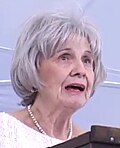
 Canada
Explanation
Alice Munro is a writer who is very good at creating short stories. Her tales show the everyday lives of ordinary people who live in small Canadian towns. Simple events, like family dinners or walks to school, reveal big feelings and important choices. Because each story is short, you can finish one during a bus ride or before bedtime. She won the 2013 Nobel Prize in Literature because these small stories touched readers all around the world.
Related Keywords
short story
A short story is a narrative form of a few hundred to several thousand words that condenses drama into a tight space. By focusing on a single moment or turning point rather than an entire life span, it leaves a powerful impression on the reader. The genre was shaped in the late 19th and early 20th centuries by writers such as Edgar Allan Poe and Anton Chekhov and spread through the rise of magazines. Alice Munro inherits this tradition while expanding its possibilities with multilayered, time-shifting structures. Her Nobel win confirms that the short story can offer depth and universality equal to that of the novel.
Canadian literature
Canadian literature, written mainly in English and French, has grown around themes such as multicultural experience and the relationship with the natural landscape. Interests have shifted from 19th-century pioneer narratives to late-20th-century explorations of identity, combining regional specificity with universal appeal. Beside figures like Margaret Atwood and Michael Ondaatje, Alice Munro is one of the authors who brought Canadian writing to global attention. Her depictions of rural Ontario connect local history with inner lives, broadening the scope of the national canon. Her Nobel Prize symbolizes Canadian literature’s emergence as an international voice.
psychological realism
Psychological realism is a literary technique that enhances verisimilitude by portraying characters’ inner lives and motives in detail. It focuses less on external action than on subtle shifts of thought and feeling, giving readers the sense of peering into a mind. The tradition reaches back to George Eliot and Henry James and was later linked to stream-of-consciousness writing by Virginia Woolf and James Joyce. Munro blends crisp narration with sharp observation to render especially female characters’ complex motivations with striking accuracy. This evokes deep empathy within a limited page count and provides her fictional worlds with layered depth.
nonlinear narrative
A nonlinear narrative rearranges events out of chronological order by using flashbacks, foreshadowing, or parallel timelines. Because readers must piece together cause and effect, the experience becomes more active and engaging. While famous in works like the film “Pulp Fiction” or the novel “One Hundred Years of Solitude,” the technique is equally powerful in short fiction. Munro often begins with a scene near the ending and then weaves multiple temporal layers, giving a short story the depth of a novel. This structure means that each rereading offers fresh discoveries.
female agency
Female agency refers to the portrayal of women as decision-making, active subjects, a key concept in feminist literary criticism. Historically, female characters were often depicted as passive, but modern literature breaks this pattern by showing complex choices and resistance. In Munro’s stories, women repeatedly confront familial and social constraints yet act according to their own desires and values. She traces how small decisions redirect an entire life course, challenging readers to reconsider the meaning of agency. This focus supplies rich material for gender studies and sociological analysis.