2018 Nobel Prize in Literature
Reason for Award
for a narrative imagination that with encyclopedic passion represents the crossing of boundaries as a form of life
Laureates
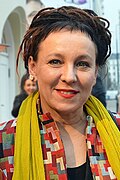
 Poland
Explanation
Olga Tokarczuk is a Polish writer who studies many books and histories before she tells her stories. In her tales, people travel across countries and meet strange animals and towns. She opens a map-like world for us, so reading feels like an adventure inside a book. Tokarczuk says we should not fear the unknown and should step outside. It is like visiting a friend’s house and learning a new game. She gives us courage to be different from others. That is why she received the Nobel Prize in Literature.
Related Keywords
boundary crossing
A recurrent motif in Tokarczuk’s work indicating the physical and mental act of traversing borders—national, linguistic, cultural, or gendered. Railways, highways, and airports serve as metaphors, illustrating how humans shed fixed identities. Readers are likewise compelled to cross genre boundaries, making textual engagement itself a border-crossing act. The concept directly addresses self-redefinition in an age of globalization and migration. It lies at the heart of the Nobel citation’s “crossing of boundaries.”
encyclopedic imagination
Her narratives braid together ancient cartography, medical history, entomology, and religious mysticism. Such synthesis reintroduces the spirit of 18th-century encyclopedists into contemporary fiction. Readers cross-reference fragments of knowledge, building a semiosphere autonomously, so reading merges with learning. The technique goes beyond postmodern intertextual play, offering an ecology of knowledge. It directly reflects the Nobel phrase “encyclopedic passion.”
polyphonic narration
Evoking Bakhtin, polyphonic narration lets multiple characters, epochs, and styles coexist on equal footing. Tokarczuk minimizes the omniscient voice, granting readers agency in viewpoint selection and denying a single truth. Sociologically it visualizes minority voices and questions power structures. Formally, short fragments are arranged like musical scores, producing an audible rhythm of voices. The technique aligns closely with postcolonial and feminist criticism.
“Flights”
Published in 2007, “Flights” won the Man Booker International Prize in its English translation. Centered on the idea that perpetual movement sustains human existence, it arranges fragments spanning over 400 years. From pickled anatomical specimens to present-day airport security, it links “body” and “journey” on multiple layers. It is one of the works emphasized by the Nobel Committee, epitomizing her boundary-crossing theme. Through translation the text itself becomes a moving entity, inviting reinterpretation across cultures.
“The Books of Jacob”
Published in 2014, this nearly 900-page historical novel reconstructs the life of 18th-century religious leader Jacob Frank through multiple narrators and documentary-style footnotes. Depicting clashes between Jewish mysticism and Enlightenment rationalism, it highlights multicultural coexistence on Europe’s periphery. Extensive archival research merges with stylistic experimentation, making it the clearest manifestation of Tokarczuk’s encyclopedic imagination. It carries high interdisciplinary value for interfaith dialogue and borderland studies.
new Polish literature
After the 1989 political shift, a literary trend emerged in Poland that privileges diverse personal and regional stories over grand national narratives. Tokarczuk stands at its center, combining postmodern form with social critique and gaining international acclaim. Her success expanded the translation market for Polish literature and encouraged peers to enter the global stage. Thus, her Nobel win symbolizes systemic changes in the country’s literary field, not merely individual achievement.
maps and vantage points
Tokarczuk repeatedly employs an “aerial” viewpoint, embedding topographical and historical maps into narrative structure. This connects local experiences to cosmic scale, fostering dialogue between part and whole. Zooming in and out unsettles reader cognition, making the world’s relativity palpable. The technique draws interest in spatial representation studies and literary mapping research.
Jungian psychology
Her early work reflects her background in clinical psychology, using Jungian archetypes and the collective unconscious as narrative scaffolding. In “Primeval and Other Times,” symbolic characters inhabit a village conceived as a microcosm mirroring the universe. Although the Jungian framework is later relativized, themes of psychic imagery and collective memory persist. Her corpus thus serves as a valuable case study for psychological approaches to literature.