2019 Nobel Prize in Literature
Reason for Award
for an influential work that, with linguistic ingenuity, has explored the periphery and the specificity of human experience
Laureates
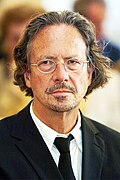
 Austria
Explanation
Peter Handke is a writer from Austria who creates books and plays. His stories carefully describe feelings and places that we usually overlook. For example, he can make the shape of a cloud or the quiet sound at night feel important. Readers learn that small everyday moments are like hidden treasures. Because of this, many people call him a “wizard of words.” The Nobel Prize in Literature was given to him because his word-magic has inspired people all over the world.
Related Keywords
linguistic ingenuity
The hallmark of Handke’s writing is its “linguistic ingenuity,” a creative use of word order, rhythm, and shifting narrative voices that awakens fresh perceptions. By deliberately deviating from standard grammar, he redirects the reader’s focus from “what is said” to “how it is said,” thereby expanding linguistic possibilities. These techniques situate him within the lineage of 20th-century experimental literature. Moreover, his crossing of genres—poetry, prose, drama—creates a polyphonic linguistic space admired by critics.
exploration of the periphery
Handke frequently situates his narratives in suburbs, rural landscapes, or linguistic and cultural borderlands rather than city centers. This choice interrogates the traditional center-periphery hierarchy and makes neglected places and memories visible. The protagonist’s journey along the margins encourages readers to “see the world from elsewhere,” highlighting the polysemy of marginal spaces. Such peripheral focus contributes to rethinking identity in an age of globalization.
metafiction
Handke employs self-referential techniques—stories about storytelling—most notably in “Repetition” and “Offending the Audience.” By foregrounding the act of creation on stage or within the text, he makes readers conscious of the conditions of fiction. The resulting blurring of reality and narrative underscores literature’s role as a device for reconstructing perception, aligning his work with post-1970s postmodern theory.
motif of travel and movement
In many works, protagonists embark on lengthy walks or train journeys, meticulously observing landscapes and people encountered en route. Physical movement parallels inner transformation, redefining the boundary between self and world. Travel also layers temporal dimensions, presenting past memories and future possibilities simultaneously. Consequently, Handke’s journeys serve not merely as plot devices but as sites of ontological inquiry.
memory and reconstruction
Handke portrays memory not as a fixed past but as a dynamic process continually rewritten by present narration. In “Storm Still,” he resurrects his family’s wartime experiences on stage, enabling audience co-experience and re-meaning of historical trauma. This approach intersects with post-memory theory and cultural memory studies, demonstrating literature’s role in the public sharing of remembrance.
subversion of theatrical contract
In “Offending the Audience,” actors break the fourth wall and verbally attack the spectators, questioning the conventions of institutional theater. The audience shifts from passive viewers to active participants, becoming co-creators of the performance. This experiment is often cited in studies of performativity and audience theory.
self-translation and translation of others
Handke not only self-translates some of his works into French but also renders Greek tragedies and contemporary French literature into German. For him, translation is a “second writing” parallel to original creation, a way of exploring resonance between languages. His practice provides a significant case study of authorial translation in translation studies.
post-war Austrian literature
In post-World War II Austria, literature grappled with Nazi memory and national identity. Influenced by Kafka yet focusing on rural areas and minority language communities, Handke forged a distinct narrative space. His work renews debates on “coming to terms with the past” (Vergangenheitsbewältigung) and introduces transnational perspectives.