2024 Nobel Prize in Literature
Reason for Award
for her intense poetic prose that confronts historical traumas and exposes the fragility of human life
Laureates
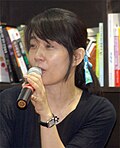
 Korea (the Republic of)
Explanation
The Nobel Prize in Literature is a very special award for writers who create wonderful stories for the world. In 2024 it went to the South Korean author Han Kang. Her books look back at sad events from the past and show how delicate human life can be. She imagines the pain of people hurt by wars or protests and wraps their feelings in gentle, powerful words. When we read her stories, we share the sadness and learn to care for others. That caring heart is the most important lesson her writing gives us.
Related Keywords
historical trauma
Historical trauma refers to violence and oppression experienced in the past that continue to exert psychological and somatic effects across generations. In Han Kang’s fiction, real events such as the Gwangju Uprising and Jeju Massacre form the narrative spine, and trauma is visualized through the characters’ silence, nightmares, and bodily sensations. By showing how past pain shapes present actions and relationships, her writing exposes the arduous processes of memory transmission and healing. Depicting historical trauma in literature is not mere documentation; it creates an imaginative space where readers co-experience the suffering. The practice allows communities to renegotiate pain and build new ethical frameworks. Han Kang’s work is a paradigmatic case frequently analyzed in global trauma studies.
poetic prose
Poetic prose is a form that retains narrative continuity while employing the rhythm and imagery of poetry. Han Kang’s style mixes short lines and repetitions, creating musical rises and falls that act directly on readers’ emotions. Gaps and silences function as part of the rhythm, letting sensation precede semantic clarity. Located between lyric and story, poetic prose prioritizes affect over information transfer. Because complex themes are compressed into dense images, multilayered interpretation is required. Through this technique Han Kang establishes the paradoxical coexistence of pain and beauty.
Gwangju Uprising
The Gwangju Uprising refers to the May 1980 pro-democracy movement in southwestern Korea that was brutally suppressed by the military. Soldiers opened fire on citizens and students demanding the lifting of martial law, causing numerous casualties. Han Kang treats the event in Human Acts, reconstructing the tragedy from the perspectives of victims and bereaved families. While grounded in primary documents and testimonies, the novel introduces the fictional device of dead narrators, blurring the boundary between history and imagination. The uprising stands as both a symbol of Korean democratization and a contentious site of state-violence memory. Literature takes on the task of presenting the event as an ethical challenge that transcends national borders.
body and violence
Han Kang repeatedly depicts bodies being attacked, wounded, or even merged with plants and minerals. The body functions not only as evidence of harm but as a ‘living text’ inscribed with history and social structures. In The Vegetarian the refusal to eat meat turns the body into a site of resistance, while The White Book uses the absent body of a stillborn sister as a catalyst for memory. Violence is internalized through silence and gaze, permeating gestures and breath. The fine-grained bodily descriptions translate violence from an abstract notion into concrete sensory experience, eliciting readerly empathy. Thus the nexus of body and violence forms the core where ethical and political questions arise.
literary testimony
Unlike courtroom testimony or official documents, literary testimony conveys experience through imagination and rhetoric. Han Kang’s multivoiced structures summon not only victims but also third parties and even the dead as witnesses, presenting a polyhedral view of events. The presence of fiction retrieves emotions and sensations omitted from formal historical records. Through empathetic immersion, readers are ethically implicated in past occurrences. Literary testimony simultaneously fills archival gaps caused by censorship and exposes the multilayered nature of truth. Han Kang’s Nobel recognition has sparked renewed global interest in this testimonial power.
female author's perspective
Han Kang sharply portrays how women’s bodies and voices are suppressed in a patriarchal Korean society. In The Vegetarian the protagonist Yeong-hye resists violence from her husband and father through silence, making silence itself the narrative core. Introducing a female viewpoint illuminates state violence and domestic violence as contiguous forms of oppression, prompting a re-examination of the border between individual and society. Han Kang offers body representations that deviate from gender norms, enriching feminist criticism. As translations circulate, the way Asian female narratives are received in global literary space also becomes an issue. The female author’s perspective is thus a key concept that visualizes layered power relations and proposes possibilities of resistance.