1902 Nobel Prize in Physics
Reason for Award
for their researches into the influence of magnetism upon radiation phenomena
Laureates
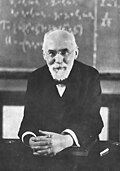
 Netherlands

Netherlands
Explanation
The light we see can be split into different colors like a rainbow. Lorentz and Zeeman discovered that when a magnet is placed near the source of light, the colored lines move a little. Zeeman watched the yellow light from sodium in a flame split into three when surrounded by a strong magnet. Lorentz used the idea that light comes from tiny particles called electrons shaking back and forth to explain the splitting. A magnet changes the way the electrons shake, so the color of the light changes too. This finding became clear evidence that electrons really exist and helped us understand how electricity moves in matter. Today the same effect is used to measure the magnetic fields on the Sun and distant stars.
Related Keywords
Zeeman effect
The Zeeman effect is the splitting of atomic or molecular spectral lines in the presence of an external magnetic field. The number of components and their polarization depend on the combination of the electron’s orbital and spin angular momentum. The splitting width is proportional to the magnetic-field strength and is given by ΔE = μB g_m m_j B. It was one of the first methods to determine the electron’s charge-to-mass ratio and predates the birth of quantum mechanics. Today it remains a standard tool for probing cosmic magnetic fields and tuning high-resolution laser spectroscopy.
Lorentz force
The Lorentz force is the force a charge q experiences in an electromagnetic field, F = q(E + v × B). The magnetic term v × B bends the trajectory of the charge sideways, producing circular or cyclotron motion. In the Lorentz–Zeeman work this force acted on bound electrons, shifting their natural frequency and causing spectral splitting. Today the concept underpins particle accelerators, mass spectrometers and magnetic-confinement devices for plasmas. The Lorentz force connects Maxwell’s equations with Newtonian dynamics and finds applications from classical electromagnetism to special relativity.
electron
The electron is the lightest stable particle with negative charge and constitutes a fundamental component of atoms. Analysis of the Zeeman effect provided crucial evidence for the electron’s existence and its charge-to-mass ratio. The electron’s spin 1/2 and orbital angular momentum interact with magnetic fields, finely splitting energy levels. Modern electronics, chemical bonding and quantum-information technologies rely on controlling the behaviour of electrons. Studies of electrons have revealed numerous quantum phenomena such as tunnelling, the quantum Hall effect and superconductivity.
atomic spectrum
An atomic spectrum is the set of lines observed when light emitted or absorbed by an atom is dispersed by wavelength. Each line corresponds to a specific electron transition and serves as a unique fingerprint for each element. Applying magnetic or electric fields shifts or splits the lines, carrying information about the surrounding environment. The Zeeman effect demonstrated that atomic spectra are highly sensitive to external magnetic fields, providing new diagnostics for physics and astronomy. Today atomic spectra underpin applications such as laser cooling, atomic clocks and elemental analysis.
magneto-optics
Magneto-optics is the study of how magnetic fields influence the propagation and polarization of light. The Zeeman and Faraday effects are classic examples, where a magnetic field modifies the refractive index or absorption of a medium. Research has led to industrial technologies such as optical isolators and magneto-optical data storage. Time-resolved magneto-optic measurements that probe ferromagnetic dynamics are indispensable for spintronics. Recently, magneto-optic effects in topological materials and plasmas under extreme conditions have shown novel optical responses.
spectroscope
A spectroscope is an instrument that disperses light into its wavelength components and records the resulting spectrum. Researchers in the late 19th century refined prism and diffraction-grating spectroscopes to detect the subtle splitting of the Zeeman effect. Spectral resolution, defined as wavelength divided by the smallest resolvable difference, had to exceed 10⁵ in high-field experiments. Modern spectroscopes equipped with CCD detectors and fiber optics serve fields ranging from chemical analysis to astronomical observation. In quantum-information experiments, ultra-high-resolution spectroscopes are essential for stabilizing laser frequency combs and calibrating atomic clocks.