1905 Nobel Prize in Physics
Reason for Award
for his work on cathode rays
Laureates
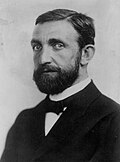
 German Empire
Explanation
Mr. Lenard studied the strange glow that appears when electricity passes through a glass tube from which most of the air has been removed. He drilled a tiny window in the wall of the tube so that the glow could come outside. The “cathode rays” that emerged were invisible but made a screen shine green, proving they carried energy. When he brought a magnet close, the rays bent, telling him they must be tiny fast-moving particles. Those particles were later called “electrons” and became the key to understanding electricity. Lenard’s experiments paved the way for inventions such as television, fluorescent lamps, and computer displays. His work gave us our first steps toward knowing how electricity travels around us.
Related Keywords
cathode rays
Cathode rays are streams of negatively charged particles that emanate from the cathode inside a high-vacuum discharge tube. In the late 19th century scientists debated whether they were waves or particles, until deflection experiments by Lenard and Thomson established the particle view. The particles were identified as electrons, and measuring their charge-to-mass ratio e/m opened the door to atomic structure research. Cathode rays make fluorescent screens glow and generate X-rays or secondary electrons when they strike metal surfaces, revealing many physical effects. Technologies such as cathode-ray-tube television and scanning electron microscopy rely on steering and modulating these electron beams.
Lenard window
The Lenard window is an ultrathin metal foil devised by Lenard to extract cathode rays from the discharge tube. Because ordinary glass absorbs electrons, he fused a few-micron-thick aluminum foil to the glass, maintaining the vacuum while allowing electrons to pass. This innovation permitted the first quantitative measurements of electron ranges and absorption in air outside the tube. The same principle is used today in particle-beam exit windows and thin-film radiation detectors. Hence, the Lenard window can be regarded as a root technology underpinning accelerator science and radiation instrumentation.
Crookes tube
The Crookes tube, invented by William Crookes, is a low-pressure vacuum discharge tube that became the basic apparatus for studying cathode rays. Inside, a cathode and an anode face each other, and when a high voltage is applied, cathode rays travel toward the anode. Various glass shapes and fluorescent coatings allowed the path and shadows of the rays to be observed visually. Lenard modified this device by adding a window so that the rays could be brought outside for measurement. The Crookes tube later evolved into cathode-ray tubes and X-ray tubes, underpinning the dawn of electron physics.
electron
The electron is the lightest particle inside atoms and carries a negative electric charge. Although J. J. Thomson officially discovered it in 1897, Lenard’s cathode-ray experiments laid crucial groundwork. Recognizing the electron transformed atomic models and opened the age of quantum theory and electrical engineering. Today electrons play central roles in chemical reactions, electrical currents, and semiconductor operation. Accelerators and electron microscopes rely on precisely controlled high-speed electrons to probe the structure of matter.
photoelectric effect
The photoelectric effect is the emission of electrons from a metal surface when it is illuminated by light. Lenard performed experiments using light to trigger electron emission and showed that wavelength, not intensity, governed the phenomenon. Einstein built on these findings in 1905 to propose the light quantum hypothesis, paving the way for quantum mechanics. The effect is exploited today in devices such as photovoltaic cells and photomultiplier tubes. A look at history shows how cathode-ray studies and the particle nature of light progressed in close interplay.
vacuum discharge
Vacuum discharge is an electrical conduction that occurs in low-pressure gas when a high voltage is applied, producing cathode and anode rays. Since the Industrial Revolution, studies of discharge phenomena have led to the discovery of gas ionization and various radiation. Lenard’s cathode-ray experiments analyzed the electrode vicinity in detail, clarifying the conditions for electron emission. Today vacuum-discharge technology underlies plasma processing, fluorescent lamps, and ion sources in accelerators. It is therefore a key phenomenon linking fundamental physics and numerous industrial applications.
X-rays
X-rays are high-energy electromagnetic waves discovered by Wilhelm Röntgen in 1895 while experimenting with cathode-ray tubes. They are produced when cathode rays strike glass or metal targets, and Lenard investigated the conditions under which they form. Owing to their strong penetrating power, X-rays are widely used in medical imaging and materials analysis. They originate mainly from bremsstrahlung and characteristic radiation when electrons decelerate in or recombine with atoms. The close historical link between cathode-ray research and X-ray physics is reflected in the consecutive Nobel Prizes awarded at the turn of the 20th century.
charge-to-mass ratio
The charge-to-mass ratio e/m is the electric charge of a particle divided by its mass and can be deduced from its trajectory in electric and magnetic fields. Lenard estimated e/m for cathode rays by simultaneous deflection experiments, establishing an upper bound on their mass. His method evolved into Thomson’s parabola technique, eventually yielding the electron’s mass. e/m remains a fundamental parameter for identifying charged particles in mass spectrometers and accelerators. Measuring e/m plays vital roles in discovering new particles and studying cosmic rays.