1927 Nobel Prize in Physics(2)
Reason for Award
for his invention of the cloud chamber, a method of making the paths of electrically charged particles visible by condensation of vapour
Laureates
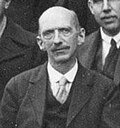
 United Kingdom of Great Britain and Northern Ireland
Explanation
Have you ever watched white clouds form on a cold mountain? Mr. Wilson recreated that cloud-making trick inside a small box. When he suddenly cooled the moist air inside, tiny clouds formed along the path of an electrically charged particle passing through. By looking at those thin cloudy lines, we can tell where the invisible particle travelled. This simple yet clever box is called a cloud chamber.
Related Keywords
cloud chamber
A detector that visualizes the path of a charged particle as a string of droplets in supersaturated vapor. Invented by Wilson in 1911, it was the primary particle detector before photographic emulsions. When a magnetic field is applied, track curvature enables momentum analysis, making the chamber instrumental in many particle discoveries. Its simple construction suits educational demonstrations and it remains widely used for radiation visualization. The principle relies on ion-induced condensation and adiabatic expansion.
supersaturated vapor
A state in which vapor exists in quantities exceeding the equilibrium amount for given temperature and pressure. In a cloud chamber, rapid expansion cools the air and moves it momentarily into this region left of the saturation curve. Minute ions or dust then act as nuclei and water droplets grow instantly, producing sharp tracks. Excessively high supersaturation increases background nucleation and degrades resolution, so precise control is essential. Similar phase-transition control appears in meteorology and crystal-growth technology.
ionization
The process by which atoms or molecules gain or lose electrons and become charged. When a charged particle passes through gas, collisions produce ion pairs that serve as condensation nuclei in a cloud chamber. The amount of ionization depends on the particle’s charge, velocity, and the medium’s density, influencing track width and darkness. Measuring ionization curves is fundamental for particle identification and dosimetry, and the same physics underlies semiconductor detectors and gas chambers.
cosmic rays
A collective term for high-energy particles arriving at Earth from outer space. In the early 20th century, cloud chambers enabled detailed studies of their nature, leading to discoveries of new particles such as muons and pions. Primary cosmic rays, mainly protons, collide with the upper atmosphere to produce secondary particle showers. Modern observatories use scintillators or Cherenkov telescopes, but the cloud chamber remains the historical cornerstone of cosmic-ray research. Understanding the origin and acceleration mechanisms of cosmic rays is still an active field today.
charged particle track
The trace left by a charged particle moving through a detection medium. In a cloud chamber it appears as a string of droplets; in gas chambers as electron–ion columns; in solids as lattices of excited atoms. From the track’s geometry one can derive direction, momentum, and energy loss, and with a magnetic field the curvature reveals charge sign. Track detection is indispensable in particle physics, nuclear medicine, and cosmic-ray observation. Modern silicon-pixel detectors and time-pix techniques have dramatically improved 3-D track reconstruction accuracy.