1930 Nobel Prize in Physics
Reason for Award
for his work on the scattering of light and for the discovery of the Raman effect named after him
Laureates
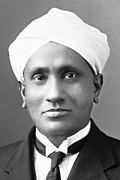
 British Indian Empire
Explanation
When light passes through water or glass, its color can change ever so slightly. Raman examined this tiny color change very carefully and discovered why it happens. He found that a small part of the light exchanges energy with the material and its color (wavelength) shifts. This is called the Raman effect. Today, the effect is used to check gemstones or medicines. You can think of it as a more detailed version of a prism experiment you might do in class.
Related Keywords
Raman effect
An inelastic scattering phenomenon in which the wavelength of scattered light shifts slightly after interacting with a material. Because it reveals molecular vibrational and rotational information, it is often called a molecular fingerprint spectrum. It was the basis for the 1930 Nobel Prize in Physics.
Stokes line
A Raman spectral line that appears at longer wavelengths when the scattered photon loses energy; it is usually the stronger, more easily detected component in analytical chemistry.
anti-Stokes line
The Raman line shifted to shorter wavelengths when the photon gains energy from a molecule. Its intensity strongly depends on temperature, allowing local temperature measurements.
surface-enhanced Raman scattering
A phenomenon in which plasmon resonance on metallic nanostructures amplifies the local electric field and strengthens Raman signals by factors of millions to trillions, enabling single-molecule spectroscopy.
vibrational energy level
Discrete energy states associated with atomic vibrations within a molecule. Raman scattering directly probes transitions between these levels.