2002 Nobel Prize in Physics(1)
Reason for Award
for pioneering contributions to astrophysics, in particular for the detection of cosmic neutrinos
Laureates
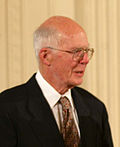
 United States of America

 Japan
Japan
Explanation
The Sun and other stars release enormous amounts of energy. Tiny particles called neutrinos are born inside them and pass through Earth almost without hitting anything. Mr. Davis placed hundreds of tons of cleaning fluid deep underground and patiently counted the few chemical changes, only a few each month, caused by solar neutrinos. Prof. Koshiba built a huge pool of pure water and covered its walls with thousands of light sensors to catch the faint flashes produced when a neutrino hits water. Their two experiments proved that neutrinos really do arrive from space, giving humanity a new way to “see” the universe. This new vision helps us understand how stars shine and how the cosmos has evolved.
Related Keywords
neutrino
Neutrinos are electrically neutral elementary particles with masses believed to be less than one-millionth that of an electron. They occur in three flavors—electron, muon, and tau—each with its antiparticle. Interacting only via the weak force, neutrinos can pass through light-years of lead without scattering, making their detection extremely challenging. They are key messengers from the Big Bang, stellar fusion, and supernova explosions, carrying energy and information outward. Precise measurements of their masses and oscillations offer clues to physics beyond the Standard Model and to the mass-energy content of the universe.
solar neutrino problem
The solar neutrino problem refers to the mystery that early detectors such as Homestake observed only about one-third of the neutrinos predicted by solar models. Scientists initially suspected errors in the solar models or in the experimental techniques. Comparative studies from the 1970s to 1990s showed that the deficit was reproducible and depended on neutrino energy. Neutrino oscillations combined with the MSW effect emerged as the leading explanation: electron neutrinos convert into other flavors en route to Earth. Results from SNO and Super-Kamiokande in the 2000s resolved the puzzle, proving that neutrinos possess mass.
chlorine detector
The chlorine detector employs the weak-interaction reaction in which an electron neutrino converts a ^37Cl nucleus into radioactive ^37Ar. Raymond Davis installed over 600 tons of tetrachloroethylene deep underground and achieved the first solar-neutrino detection with this method. The key was extracting just a few dozen ^37Ar atoms each month by purging the tank with helium and counting them via mass spectrometry in an ultra-low-background setup. Because the reaction threshold is 0.814 MeV, the detector is primarily sensitive to high-energy ^8B neutrinos. The technique laid groundwork for later gallium and water Cherenkov detectors and advanced the chemistry of ultra-rare event detection.
water Cherenkov detector
A water Cherenkov detector exploits Cherenkov radiation, the bluish light emitted when a charged particle travels through water faster than light does in that medium. When a neutrino scatters off an electron or nucleus in the water, the resulting charged particle produces this distinctive light cone. Photomultiplier tubes lining the tank walls record the pattern and timing of the photons, allowing precise reconstruction of the event’s position and incoming direction. Detectors such as Kamiokande and Super-Kamiokande, equipped with thousands of PMTs, have measured solar, atmospheric, and supernova neutrinos with high statistics. Combining huge target mass with directional sensitivity, this technology underpins next-generation observatories like Hyper-Kamiokande and plays a key role in multimessenger astrophysics.
Supernova 1987A
Supernova 1987A, observed in February 1987 in the Large Magellanic Cloud, was the brightest supernova seen in modern times. Kamiokande-II detected a burst of 12 neutrino events that arrived about three hours before the optical light, matching theoretical expectations. It was the first direct observation of neutrinos from an astrophysical source, providing strong evidence for core-collapse supernova models. The data supported predictions that roughly 99 % of the explosion’s energy is carried away by neutrinos. The event marked the dawn of the multimessenger era, combining optical and neutrino astronomy.
neutrino oscillation
Neutrino oscillation is a quantum phenomenon in which a neutrino changes flavor between production and detection. It implies that neutrinos have mass and that flavor eigenstates are mixtures of mass eigenstates. The oscillation probability depends on the ratio L/E and on mixing angles together with the squared mass differences Δm^2. Definitive evidence came from atmospheric neutrinos in Super-Kamiokande and solar neutrinos in SNO. Current long-baseline accelerator experiments are probing CP violation and the mass hierarchy using the same effect.