2003 Nobel Prize in Physics
Reason for Award
for pioneering contributions to the theory of superconductors and superfluids (Sov. Phys. JETP 5 (1957) 1174–1182; Zh. Eksp. Teor. Fiz. 32 (1957) 1442–1452; Zh. Eksp. Teor. Fiz. 20 (1950) 1064–1082; Phys. Rev. 140 (1965) A1869–A1888; Phys. Rev. 147 (1966) 119–130; Phys. Rev. Lett. 29 (1972) 1227–1230; Phys. Rev. Lett. 31 (1973) 352–355; Rev. Mod. Phys. 47 (1975) 331–414; Phys. Rev. Lett. 46 (1981) 211–214)
Laureates
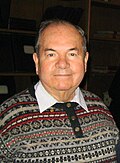
 United States of America,
  Russian Federation
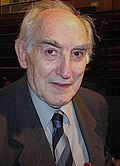
Russian Federation
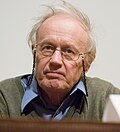
 United Kingdom of Great Britain and Northern Ireland, United States of America
Explanation
When electricity flows through a wire it usually produces heat. If a metal is cooled to extremely low temperatures, however, it enters a strange state called “superconductivity,” where current flows without any heat. Likewise, when liquid helium is cooled even further it becomes a “superfluid” that can climb the walls of its container and flow without friction. Drs. Abrikosov, Ginzburg and Leggett, winners of the 2003 Nobel Prize in Physics, discovered ideas that explain how these wonders occur. Their work now helps power maglev trains and the MRI machines found in hospitals.
Related Keywords
superconductivity
Superconductivity is the phenomenon in which a material loses all electrical resistance below a critical temperature. It was first observed in mercury by Heike Kamerlingh Onnes in 1911. The effect is explained by electrons forming phonon-mediated Cooper pairs that undergo Bose condensation. Hallmarks include flux quantization and the Josephson effect, both manifestations of macroscopic quantum coherence. A wide range of materials—from Nb-Ti alloys to high-Tc cuprates—exhibit superconductivity and are used in technologies from cryogenic power cables to quantum computers. The 2003 Nobel Prize honored theories that allow superconductivity to persist even in strong magnetic fields.
superfluidity
Superfluidity is a quantum state in which a liquid flows without any internal friction. Kapitza observed it in helium-4 in 1937, and a richer form was discovered in helium-3 during the 1970s. The fluid can pass through microscopic capillaries without resistance and even climb the walls of its container. In helium-3, spin-triplet Cooper pairing leads to anisotropic order parameters that give rise to three distinct phases (A, A1, B). Superfluid helium serves as a model system for phenomena ranging from cosmic inflation to neutron-star interiors. Leggett’s theoretical framework captured these properties and earned him part of the 2003 Nobel Prize.
Abrikosov vortex lattice
When a magnetic field is applied to a type-II superconductor, flux enters in discrete quanta Φ0 = h/2e and forms vortices. Abrikosov’s analysis of the Ginzburg–Landau equations showed that these vortices arrange themselves into a hexagonal lattice. The spacing is set by the field strength, and superconductivity is destroyed once the vortex cores overlap. The lattice has been imaged directly with scanning tunneling microscopy and small-angle neutron scattering. The concept underlies the design of high-field Nb₃Sn coils and vortex-pinning strategies in applied superconductivity. Similar vortex lattices also appear in Bose-condensed cold-atom gases and quantum Hall systems, making them a unifying motif in modern quantum matter.
Ginzburg–Landau theory
The Ginzburg–Landau (GL) theory, proposed in 1950, is a macroscopic effective-field description that couples a complex order parameter ψ representing the superconducting condensate to the electromagnetic field in a free-energy functional. It naturally yields expressions for the critical field, London penetration depth λ, and coherence length ξ, and introduces κ = λ/ξ to distinguish type-I from type-II behavior. By treating temperatures near the transition, GL theory dovetails with Landau’s general theory of phase transitions and can be adapted to many ordered states beyond superconductivity. Its coefficients can be derived microscopically from BCS theory, and extensions incorporating higher-order or non-local terms have broadened its applicability. Time-dependent GL equations are widely used in simulations of superconducting dynamics, guiding the design of wires and Josephson-junction networks. As a result, GL theory remains an indispensable tool for estimating critical current densities and exploring new superconducting materials.
superfluid helium-3
Helium-3 atoms are fermions and cannot Bose-condense individually, but when cooled below about 10⁻³ K they form weakly bound Cooper pairs. Leggett’s theory identified the pairs as spin-triplet p-wave and introduced order parameters for three phases, A, A1, and B. Superfluid ^3He exhibits anisotropic gaps, topological surface states, and massless Andreev bound states, making it a playground for exotic quasiparticles. Because of its rich pattern of spontaneous symmetry breaking and multiple Goldstone modes, it provides analogies to the Higgs mechanism and even dark energy in cosmology. Experiments using ultra-low-temperature NMR and mechanical resonators have tested phenomena such as quantum turbulence and long-lived coherent oscillations. These studies have stimulated advances in quantum-measurement techniques and cryogenic engineering.