2024 Nobel Prize in Physics
Reason for Award
for foundational discoveries and inventions that enable machine learning with artificial neural networks
Laureates
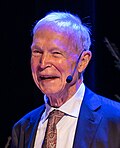
 United States of America
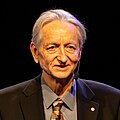
 United Kingdom of Great Britain and Northern Ireland
Explanation
Scientists invented a way for computers to “learn.” Many small dots, called neurons, are connected by lines just like in our brains and they pass messages to each other. Mr. Hopfield and Mr. Hinton used this idea so a computer can find rules in pictures or words by itself. If you show the computer many photos of dogs and cats, it learns to tell which is which. The amazing part is that no one has to give the computer every single answer—it discovers the differences on its own. Today this idea helps in tools like translation apps and voice assistants that we use daily.
Related Keywords
artificial neural network
An artificial neural network is a computational model made of many nodes connected by weighted links, mimicking networks in the human brain. Signals propagate through input, hidden, and output layers, and training algorithms adjust the weights so the system adapts to a task. The model handles pattern recognition, prediction, and generation, outperforming earlier methods in image classification and speech recognition. When built with many layers it is called deep learning, allowing automatic extraction of abstract features. Neural networks now serve natural language processing, materials discovery, and robotics, augmenting human decision making. Although training demands large datasets and powerful hardware, research on model compression and edge deployment is rapidly advancing.
Hopfield network
The Hopfield network is a recurrent, fully connected system of binary or continuous nodes that recalls memories by minimizing an energy function. Each stable point acts as an attractor, allowing incomplete inputs to converge to the nearest stored pattern. The mechanism serves error correction and pattern completion and has been applied to DNA sequence alignment and combinatorial optimization. Analytically, it maps onto the Ising model, enabling studies of capacity and dynamical transitions. Variants with continuous states, sparse connectivity, or layered structures have been proposed, and the recent deep Hopfield net revives the paradigm for large-scale memory. Implementation on quantum annealers is being explored, making the model a classic bridge between physics and information science.
Boltzmann machine
The Boltzmann machine is an energy-based stochastic neural network whose node states update according to the Boltzmann distribution. With hidden nodes it can capture complex latent structure, and learning proceeds via gradient methods grounded in sampling. The Restricted Boltzmann Machine (RBM) retains only visible-to-hidden connections, greatly boosting computational efficiency. Stacking RBMs forms a Deep Belief Network that successively learns higher-order features and popularized unsupervised pretraining. Modern generative models, including energy-based GANs and diffusion models, inherit conceptual foundations from Boltzmann machines. Extensions include quantum versions and continuous-state forms, making the model a hallmark of the fusion between statistical physics and machine learning.
deep learning
Deep learning refers to neural networks with many layers that learn hierarchical representations. Lower layers capture primitive features such as edges or colors, whereas higher layers encode conceptual abstractions tailored to a task. A convolutional network’s decisive victory in the 2012 ImageNet competition triggered explosive research growth. Today the Transformer architecture dominates natural language and vision tasks, using self-attention to learn long-range dependencies. Applications now span medical imaging, protein structure prediction, and drug discovery, catalyzing advances in science. Concerns about computational cost, fairness, and interpretability fuel work on efficient algorithms and ethical frameworks.
associative memory
Associative memory refers to the ability to recover complete information from partial or noisy input. The Hopfield network is a classic implementation: by energy minimization it converges to the nearest stored pattern. Hinton’s probabilistic extensions enable memory retrieval under uncertainty. Associative memory underpins practical tasks such as error correction, image restoration, and missing-data imputation. In neuroscience it is compared with hippocampal pattern completion, serving as a computational model. Recent work on sparse coding and high-capacity algorithms seeks to align machine associative memory more closely with human cognition.
energy landscape
An energy landscape depicts all possible states of a system and their energies as a terrain of valleys and ridges. In the Hopfield model, valleys correspond to memory patterns and ridges to transition barriers, illustrated by the metaphor of a rolling ball. Optimization problems struggle with escaping local minima, inspiring stochastic perturbations and thermal annealing to cross high ridges. In deep learning, analyzing the loss landscape is crucial for understanding generalization. Physics employs similar views in protein folding and glass transitions, making the landscape idea a shared interdisciplinary language. Advances in visualization now accelerate comprehension of high-dimensional models.
Hebbian learning
Hebbian learning states that “neurons that fire together wire together,” forming a foundational model of synaptic plasticity. The Hopfield network’s weight initialization can be seen as a straightforward application of the Hebb rule. This local learning principle enjoys strong biological plausibility and is vital in spiking neural networks and neuromorphic chip design. Statistical-mechanical analysis has explored Hebbian capacity limits and noise robustness. Reinforcement and meta-learning studies embed Hebbian updates to achieve on-device adaptation. The concept remains a key link between neuroscience and advancing AI.
weight optimization
Weight optimization lies at the heart of neural network learning, seeking weight sets that minimize an objective function. Classical approaches use gradient descent computed efficiently via back-propagation. Energy-based models require stochastic updates such as Gibbs sampling or Contrastive Divergence. Optimization faces local minima and saddle points, prompting algorithms like Momentum, Adam, and RMSProp. Approximations to second-order information and noise-injection strategies are actively studied for improving generalization. Distributed training and quantum optimization are further accelerating learning for large-scale models.
generative model
A generative model produces new data samples drawn from a learned distribution. The Boltzmann machine is an early generative model, probabilistically recreating patterns similar to training data at the visible nodes. More recently GANs, VAEs, and diffusion models have emerged, generating high-resolution images, audio, and text. Applications include data augmentation, creative design, and accelerated simulation. At the same time, issues such as fake content and copyright concerns demand ethical guidelines. Physics-informed generative models are revolutionizing materials discovery and fluid simulations in scientific research.
statistical physics
Statistical physics analyzes macroscopic properties of many-particle systems using probabilistic methods. Hinton incorporated the Boltzmann distribution and temperature into learning algorithms, bridging machine learning and statistical physics. This viewpoint introduced energy, free energy, and phase-transition concepts into model analysis. Statistical-physics techniques aid capacity analysis and generalization-error estimation in neural networks. Deeper links with information theory show spin-glass theory illuminating learning dynamics in complex networks. Statistical physics is expected to remain a vital theoretical foundation for future AI algorithms.