1904 Nobel Prize in Physiology or Medicine
Reason for Award
for his work on the physiology of digestion, through which knowledge on vital aspects of the subject has been transformed and enlarged
Laureates
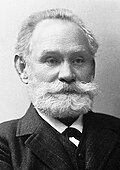
 Russian Empire
Explanation
When we eat, saliva appears in the mouth and special juices flow in the stomach and intestines to break food into small pieces. Pavlov gently cared for dogs and carefully measured when and how much of these juices were produced. He noticed that a dog would drool when it heard a bell even before seeing food, showing that the body links the bell with a meal. This link is called a “conditioned reflex.” His work showed that the brain and internal organs cooperate to control digestion and gave clues for treating illness. In a way, our own hunger before dinner is a little like the dog that links the bell to food.
Related Keywords
digestive physiology
Digestive physiology is the discipline that studies how ingested food is broken down, absorbed and utilized by the body. Multiple organs—mouth, stomach, small intestine, colon, liver and pancreas—work in concert under precise neural and hormonal control. Before Pavlov, digestion was viewed mainly as a chemical dissolution, but he showed that neural reflexes play a crucial role. Today the field also encompasses the contributions of the microbiota and immune system. Understanding digestive physiology is essential for preventing and treating obesity, diabetes and inflammatory bowel disease.
conditioned reflex
A conditioned reflex is a learned phenomenon in which a neutral stimulus, when repeatedly paired with an unconditioned stimulus, comes to elicit the same physiological response. Pavlov paired a bell (neutral stimulus) with food (unconditioned stimulus) and showed that dogs would salivate to the bell alone. The discovery laid the foundation for behaviorism, emphasizing stimulus-response associations in shaping behaviour. Conditioned reflexes are now used to explain cue-induced relapse in drug addiction and the acquisition of phobias. Contemporary neuroscience explores their molecular basis in limbic circuits and synaptic plasticity.
gastric juice
Gastric juice is the digestive fluid secreted by the gastric glands, composed mainly of hydrochloric acid and the enzyme pepsin. The highly acidic milieu denatures proteins and facilitates their hydrolysis by pepsin. Pavlov collected gastric juice directly and quantified its acidity, demonstrating that neural stimuli modulate its output. Excess acid secretion predisposes to ulcer formation, making gastric juice an important target in drug development. Modern gastroenterology uses proton-pump inhibitors and similar agents to regulate acid levels and treat ulcers and gastro-oesophageal reflux disease.
Pavlov pouch
The Pavlov pouch, or experimental miniature stomach, is a surgically isolated portion of a dog’s stomach that preserves its blood supply and innervation and drains externally through a fistula. This arrangement allows long-term, uncontaminated collection of gastric secretions without disturbing overall digestion. Pavlov used it to record the temporal relationship between stimuli and secretion in fine detail. The apparatus later became the standard for acid-secretion assays in physiology laboratories worldwide. Today it is recognized as a historical precursor to endocrine cannulation and microdialysis techniques.
vagus nerve
The vagus nerve is the tenth cranial nerve, extending from the brainstem to abdominal organs and serving as the main parasympathetic component of the autonomic nervous system. It regulates diverse functions such as gastric acid secretion, heart rate, respiration and phonation. Pavlov showed that cutting or stimulating the vagus drastically alters gastric juice output, proving neural control of digestion. In recent years, vagus-nerve stimulation therapy has been applied to epilepsy, depression and inflammatory bowel disease. The nerve is also being studied as a signalling pathway from the gut microbiota to the brain.
pancreatic secretion
Pancreatic juice is an alkaline fluid secreted by the pancreas, rich in digestive enzymes such as amylase, lipase and trypsin. Pavlov demonstrated that chyme entering the duodenum or exogenous secretin injections stimulate pancreatic secretion, clarifying the regulation of the exocrine pancreas. The juice neutralises gastric acid and optimises enzyme activity in the small intestine. Pancreatic insufficiency, seen in chronic pancreatitis or cystic fibrosis, causes maldigestion and nutritional deficits. Measuring pancreatic secretion remains a gold standard for assessing pancreatic function and drug efficacy.
salivary glands
Salivary glands are exocrine glands in the oral cavity that produce saliva, marking the first step of digestion. Pavlov created parotid fistulas in dogs and meticulously measured saliva flow in response to visual and auditory cues. Saliva contains amylase and antimicrobial peptides, aiding mastication and swallowing while protecting oral tissues. Its volume and composition are autonomically regulated and readily altered by stress or drugs. Saliva analysis is increasingly used for hormone monitoring and disease biomarker discovery.
canine model
Dogs have long been used in digestive physiology research because their gastrointestinal anatomy resembles that of humans and their social nature facilitates learning experiments. Pavlov established the chronic fistula technique in dogs, enabling long-term observation of physiological processes. From an animal-welfare perspective, his meticulous husbandry and postoperative care are regarded as precursors to today’s 3Rs—Replacement, Reduction and Refinement. Findings from canine studies of neuro-digestive interaction informed human ulcer therapies and conditioned-stimulus treatments. Dogs remain important large-animal models for surgical techniques and preclinical evaluation of medical devices.