1905 Nobel Prize in Physiology or Medicine
Reason for Award
for his investigations and discoveries in relation to tuberculosis
Laureates
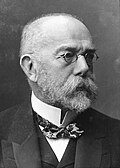
 German Empire
Explanation
Long ago, many people died from a sickness called tuberculosis. Nobody knew what caused it because the culprit was too small to see. German doctor Robert Koch used a microscope and special dyes to spot the tiny germ. He showed that this bacillus, now called “Koch’s bacillus,” was the real cause of tuberculosis. Thanks to his discovery, doctors learned how the disease spreads and could start making medicines. That is why Dr. Koch was awarded the Nobel Prize.
Related Keywords
tuberculosis
Tuberculosis is a chronic infection caused by Mycobacterium tuberculosis. It primarily affects the lungs but can spread to bones, the meninges, and other organs. The disease is transmitted through the air when a patient coughs or sneezes, releasing bacilli-laden droplets. Symptoms such as fever, night sweats, and weight loss develop slowly, so diagnosis is often delayed. Multi-drug antibiotic therapy is the standard treatment, yet the rise of drug-resistant strains poses a major global health challenge.
Mycobacterium tuberculosis
Koch’s bacillus, first described by Robert Koch in 1882, is an acid-fast rod-shaped bacterium. Its cell wall contains a thick layer of mycolic acids, making it resistant to acid-alcohol decolorization. It grows extremely slowly, requiring three to six weeks to form colonies on solid media. The organism is hardy, surviving desiccation and low temperatures for long periods, complicating infection control. Genomic studies have revealed several lineages—human, bovine, African and others—within the Mycobacterium tuberculosis complex.
infectious disease
An infectious disease is any illness caused by the invasion and multiplication of a pathogenic organism in the body. Pathogens include bacteria, viruses, fungi and parasites, each with distinct biological properties. Transmission routes vary—airborne, contact, food, water or vector-borne—and are disease-specific. Vaccination, improved sanitation and antimicrobial drugs are the main pillars of infection control. Globalization and climate change have led to the rise of emerging and re-emerging infections, making international cooperation crucial.
bacterial culture
Bacterial culture is the laboratory technique of growing bacteria artificially for identification and susceptibility testing. Solid media allow observation of colony morphology and pigment production. Liquid media facilitate bulk growth and metabolic studies. Culture conditions—temperature, pH, oxygen tension and nutrients—must be optimized for each organism’s physiology. Slow-growing bacteria such as M. tuberculosis require prolonged incubation, so culture is often combined with rapid diagnostic assays.
staining technique
Staining techniques visualize cells or microorganisms by impregnating them with dyes for microscopic examination. For M. tuberculosis, Ziehl–Neelsen staining and auramine-rhodamine fluorescence staining are commonly used. Staining affinity depends on cell wall or membrane components and aids in classification and identification. Improper decolorization or mounting can cause false-negative or false-positive results. Recently, fluorescence staining combined with digital image analysis has enabled automated specimen interpretation.
bacteriology
Bacteriology is the branch of biology that studies the morphology, metabolism, genetics and pathogenicity of bacteria. The discipline was founded on the concepts of aseptic technique and pure culture developed by Pasteur and Koch. Bacteriology has applications not only in medicine but also in food fermentation and biotechnology. Advances in genome sequencing allow phylogenetic analysis and functional prediction at the molecular level. It is an interdisciplinary field tackling clinically important issues such as antibiotic resistance and biofilm formation.