1981 Nobel Prize in Physiology or Medicine(1)
Reason for Award
for discoveries concerning the functional specialization of the cerebral hemispheres
Laureates
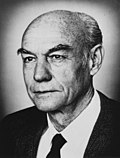
 United States of America
Explanation
Our brain is divided into a left half and a right half. Mr. Sperry showed with clever experiments that each half is good at different jobs. The left side is better at talking and reading words, while the right side is better at pictures, music, and understanding space. He studied animals and patients in which the “corpus callosum,” the bridge connecting the halves, was cut. Thanks to this work, we learned clearly how the two halves share the brain’s tasks.
Related Keywords
corpus callosum
A bundle of about 200 million nerve fibers connecting the left and right cerebral hemispheres. Its section blocks information exchange, revealing each hemisphere’s independent functions.
split-brain
A condition in which the hemispheres are functionally separated by callosal transection. Provides patient and animal models for studying cognitive lateralization.
lateralization
The phenomenon in which specific neural functions (e.g., language) are predominantly localized to one hemisphere. Measured by behavioral and imaging studies.
neural plasticity
The ability of synapses and networks to reorganize in response to experience or injury. Sperry’s rewiring experiments provided direct evidence for such plasticity.
dual consciousness
A multicomponent model of consciousness suggested by independent processing in each hemisphere of split-brain patients, stimulating debates in philosophy and neuroscience.