2007 Nobel Prize in Physiology or Medicine
Reason for Award
for their discoveries of principles for introducing specific gene modifications in mice by the use of embryonic stem cells
Laureates

 United States of America
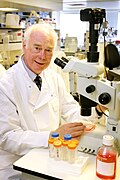
 United Kingdom of Great Britain and Northern Ireland

United States of America
Explanation
Our bodies are built from “genes,” which act like blueprints. The three scientists who won the 2007 Nobel Prize found a way to rewrite a chosen piece of the blueprint in mice. The key is a special cell called an “embryonic stem cell,” which can become any body part. Researchers first add a new gene to this cell, then place the cell back into a mother mouse. The baby mice that are born carry only the targeted change. Thanks to this trick, we can study diseases safely and create better medicines.
Related Keywords
embryonic stem cell
A pluripotent cell isolated from the pre-implantation embryo. It can self-renew indefinitely and differentiate into every somatic and germ-line lineage. ES cells tolerate extensive genetic manipulation with minimal karyotypic abnormalities. Homologous recombination in ES cells makes precise locus-specific modification possible. Because they contribute to the germ line, introduced mutations can be transmitted to offspring.
homologous recombination
A reaction in which two DNA molecules with homologous sequences exchange genetic information. In mammals it serves as a pathway for double-strand break repair. Providing donor DNA with matching arms allows precise gene replacement or disruption. The laureates showed it occurs in ES cells at roughly one event per 1,000 cells. Modern CRISPR/Cas9 editing still relies on the cell’s homologous recombination machinery to complete precise repairs.
knockout mouse
A mouse strain in which a specific gene is deleted or inactivated. It is the premier in-vivo model for examining gene function at the organismal level. The laureates’ methods enabled large-scale production beginning around 1990, and more than half of all genes have now been targeted. Phenotypic analysis impacts developmental biology, immunology, behavior science and more. Knockout models are invaluable for drug screening in human disease research.
gene targeting
A technique that uses homologous recombination to introduce designed mutations at defined genomic loci. Combining positive and negative selection enriches correctly targeted clones. It encompasses knock-outs, knock-ins and conditional alleles. Applications extend beyond mice to rats, chickens and human iPS cells. Its precision set the benchmark later adopted by CRISPR-based genome editing.
positive-negative selection
A selection scheme that places a drug-resistance gene (neo) and a drug-sensitivity gene (HSV-tk) on the targeting vector. Correct homologous recombination retains neo but loses tk, so clones resistant to G418 and ganciclovir are highly enriched for proper events. Random integrations keep tk and are killed by ganciclovir. The approach dramatically raised the HR/RI ratio and enabled modification of non-selectable genes. It remains a core strategy when designing conditional alleles.
germline transmission
The process by which modified ES cells contribute to the embryo, form gametes, and pass the genetic change to the next generation. Researchers verify chimerism by coat color or PCR and then establish lines homozygous for the altered allele. Established strains are shared through global mouse repositories. Transmission efficiency depends on ES cell quality and microinjection skill. The concept also underpins studies aiming at germline gene correction in humans.
Cre-loxP system
A bacterial recombinase, Cre, excises or inverts DNA between loxP sites. Crossing mice carrying a “floxed” allele with a Cre driver enables tissue- or stage-specific gene alteration. Drug-inducible CreERT2 allows temporal control in adult animals. As an extension of the laureates’ work, the system is essential for multistep disease models and gene-network analyses. Combined Cre and CRISPR strategies are now being explored for multiplex editing.
transgenic technology
A classical method introducing foreign DNA randomly into zygotes or pronuclei to achieve over-expression. Microinjection in the early 1980s opened the door to functional gene analysis. However, unpredictable insertion sites and variable copy numbers complicate phenotype interpretation. Gene targeting, developed by the laureates, overcame these limitations by enabling precise modifications. Modern studies often combine transgenic and targeting approaches to manipulate complex genetic networks.