2016 Nobel Prize in Physiology or Medicine
Reason for Award
for the discoveries of mechanisms for autophagy
Laureates
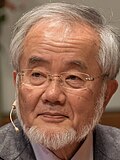
 Japan
Japan
Explanation
The cells that build our bodies work hard every day and need to clear away old parts. They do this with a cleaning system called “autophagy,” which means “self-eating.” In autophagy, a tiny bag called an autophagosome forms inside the cell and wraps up the unwanted parts. The bag then joins a “lysosome,” a kind of recycling factory, and the contents are broken down into pieces that can be used again. Dr. Yoshinori Ohsumi studied the yeast used for bread and sake and was the first to show clearly how this process works. His discovery revealed an essential way that cells stay healthy and has helped researchers study many diseases. For this achievement he received the Nobel Prize in 2016.
Related Keywords
autophagy
Autophagy is a cellular recycling system in which a cell degrades and reuses its own components; the word literally means “self-eating.” A double-membrane autophagosome engulfs unwanted proteins or organelles and fuses with the lysosome/vacuole where hydrolases break them down. It supplies energy during starvation, maintains protein quality, and eliminates invading microbes, giving it multiple physiological roles. Dr. Ohsumi identified the ATG genes and established the molecular foundation of this pathway. Dysregulated autophagy is linked to neurodegeneration, cancer, and metabolic disorders, making it an attractive drug target.
autophagosome
The autophagosome is the double-membrane vesicle formed during autophagy. It sequesters cytoplasm and damaged organelles inside its lumen. Within 10–20 minutes it fuses with a lysosome/vacuole so that the contents are degraded. Membrane expansion requires Atg8-PE conjugation and the Atg12–Atg5–Atg16 complex. Visualization with GFP-LC3 has become a standard assay for measuring autophagic activity.
ATG genes
ATG genes encode the essential factors required for autophagy. Ohsumi’s original discovery of 15 genes in budding yeast has grown to more than 40 identified members. They encompass the Atg1 kinase complex, the Atg9 transporter, and the ubiquitin-like conjugation enzymes, among others. Most ATG genes are conserved in mammals, where homologs such as ULK1, Beclin 1, and LC3 perform analogous functions. Knockout models show severe phenotypes—neonatal lethality, neurodegeneration, immune defects—underscoring their indispensable roles.
budding yeast
The budding yeast Saccharomyces cerevisiae is a unicellular eukaryote and a premier model organism in genetics. Its short generation time and efficient homologous recombination enable large-scale mutant screens. Dr. Ohsumi exploited the yeast vacuole—functionally analogous to the lysosome—allowing autophagy to be observed by light microscopy. Many ATG genes discovered in yeast are conserved in mammals, facilitating the modeling of human diseases. Thus, yeast serves as an essential bridge from fundamental biology to medical applications.
lysosome
The lysosome (vacuole in yeast) is an acidic organelle packed with hydrolytic enzymes that degrade cellular waste. It fuses with the autophagosome to break down the engulfed material into amino acids, fatty acids, and sugars. Its interior pH of 4–5 is maintained by a V-ATPase, optimizing enzyme activity. Lysosomal dysfunction causes a variety of disorders, including lysosomal storage diseases and neurodegeneration. Ohsumi’s work clarified that autophagy is a lysosome-dependent degradation route.
TOR kinase
TOR (Target of Rapamycin) kinase is a serine/threonine kinase that senses cellular nutrient status. When nutrients are abundant, TOR is active, promotes protein synthesis, and suppresses autophagy. Under starvation or stress, TOR is inactivated, leading to Atg13 dephosphorylation, activation of the Atg1 complex, and induction of autophagy. Rapamycin inhibits TOR and is widely used as an autophagy inducer in both research and clinical trials. Modulating TOR signaling is central to therapeutic strategies for cancer, diabetes, and aging.
ubiquitin-like conjugation
Autophagy employs two ubiquitin-like proteins, Atg12 and Atg8, that are activated through enzyme cascades. Atg12 covalently binds Atg5 and, with Atg16, forms an E3-like complex. This complex catalyzes the conjugation of Atg8 to the lipid phosphatidylethanolamine (PE), driving autophagosome membrane expansion and cargo selection. The reactions proceed via Atg7 (E1-like) and Atg10/Atg3 (E2-like) enzymes, illustrating evolutionary parallels with the ubiquitin system. Defects in these conjugation steps impair autophagosome formation and are linked to multiple pathologies.
mitophagy
Mitophagy is a selective form of autophagy that degrades mitochondria. By removing damaged mitochondria it limits reactive oxygen species and maintains cellular quality control. Atg32 mediates recognition in yeast, whereas PINK1/Parkin and BNIP3 pathways operate in mammals. Defective mitophagy is closely associated with neurodegenerative diseases such as Parkinson’s and with cardiomyopathies. Ohsumi’s basic research greatly contributed to establishing the concept of selective autophagy including mitophagy.