1944 Nobel Prize in Chemistry
Reason for Award
for his discovery of the fission of heavy nuclei
Laureates
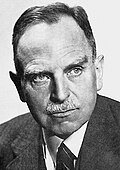
 Greater German Reich
Explanation
Everything around us is made of tiny units called atoms. Otto Hahn discovered that the central part of an atom, the nucleus, can be split apart. When the nucleus breaks, it releases a huge amount of energy and some tiny particles called neutrons. It is like popping a party cracker: a small trigger produces a big burst. This finding became the basis for nuclear power plants that generate electricity and for powerful research tools. It also made people think carefully about how such strong energy should be used, because it can be turned into weapons.
Related Keywords
nuclear fission
Nuclear fission is the process in which a heavy atomic nucleus splits into two or more lighter nuclei. During the split about 200 MeV of energy is released as kinetic energy of the fragments and as gamma radiation. The energy density is millions of times that of coal, enabling both power generation and powerful explosives. The fragments are usually neutron-rich and undergo successive β decays, producing a variety of radioactive isotopes. Hahn’s discovery provided the first experimental proof of this phenomenon and opened the fields of nuclear chemistry and nuclear engineering.
heavy nuclei
‘Heavy nuclei’ generally denotes elements with mass numbers around 200 or above; uranium and thorium are typical examples. Such nuclei contain many protons, so Coulomb repulsion makes it harder to balance surface tension. Consequently, when they absorb a neutron they can more readily surmount the fission barrier. Understanding the fission behavior of heavy nuclei is crucial for fuel selection and waste management in nuclear technology. Hahn’s chemical analyses revealed that heavy nuclei are unexpectedly prone to splitting.
chain reaction
A chain reaction occurs when neutrons emitted from one fission event cause additional fissions, allowing the process to sustain itself. If the amount of fuel exceeds the critical mass, neutron production outweighs losses and the reaction continues. In reactors, control rods and coolants adjust neutron numbers so that only heat is extracted safely. Without control, neutron population grows exponentially, releasing vast energy in a very short time. Mastery of chain reactions underpins both nuclear safety and weapon design.
Uranium-235
Uranium-235 is an isotope that makes up about 0.7 % of natural uranium and has a high probability of fission with thermal neutrons. Although enrichment techniques were undeveloped in Hahn’s era, the isotope was quickly recognized as the cornerstone of chain reactions. Its bare-sphere critical mass is about 52 kg, making it a key design parameter for bombs and pressurized-water-reactor fuel. After burn-up, isotopes such as plutonium-239 are bred, complicating the nuclear fuel cycle. Accurate nuclear data on U-235 are strategically important for energy policy and non-proliferation regimes.
neutron
Neutrons are electrically neutral nucleons that, together with protons, form atomic nuclei. Because they carry no charge, they are not repelled by the nucleus and can easily induce reactions once inside. They initiate fission and act as ‘catalysts’ that propagate the next fission events. In reactor cores, moderators slow them down to thermal energies where the fission cross-section is highest. Conversely, fast reactors exploit high-energy neutrons and must manage a different neutron economy.
nuclear power generation
Nuclear power generation produces electricity by using the heat released from fission to drive steam turbines. Since commercial reactors began operating in the 1950s, many countries have adopted the technology as a low-carbon source of large-scale energy. Multiple safety systems—primary and secondary coolant loops, containment structures, and control rods—keep the chain reaction under strict control. However, accidents can release radioactivity, and events such as Chernobyl and Fukushima have prompted continuous revisions of safety standards. Fuel reprocessing and waste management make the nuclear fuel cycle a complex interplay of technical, economic and social issues.