1959 Nobel Prize in Chemistry
Reason for Award
for his discovery and development of the polarographic methods of analysis
Laureates
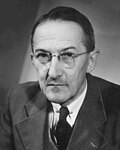
 Czechoslovakia
Explanation
When we send electricity through water, watching how the current changes tells us what is dissolved inside. Mr. Heyrovský let tiny drops of mercury fall into the liquid while he slowly changed the voltage and measured the current. From the shape of the graph he could instantly know which metals or medicines were present and in what amount. This method is called polarography. It is like a magic ruler that quickly tells us how much sugar is in juice. Thanks to this idea, doctors and scientists can now test medicines or check river water quickly and accurately.
Related Keywords
polarography
An electrochemical analytical technique in which a continuously varying voltage is applied while the current is recorded, enabling identification and quantification of dissolved species. The constantly renewed dropping mercury electrode and its wide potential window make the method suitable for trace metals and organic compounds. The resulting S-shaped curve provides half-wave potentials and diffusion currents as key parameters. Polarography laid the groundwork for modern pulse voltammetric techniques.
dropping mercury electrode
An electrode consisting of mercury drops that fall from a capillary every few seconds. Continuous renewal minimizes errors from adsorption or contamination. The large hydrogen overpotential of mercury suppresses hydrogen evolution, providing a wide cathodic potential range. This allows sensitive detection of reduction waves of trace constituents.
half-wave potential
The potential on a polarogram at which the current equals exactly half the diffusion-limited plateau value. It obeys the Nernst equation and is characteristic of each ion, serving as a qualitative identifier. In the presence of ligands the shift of E_1/2 yields formation constants, making it useful in coordination chemistry.
Ilković equation
An expression linking diffusion current i_d to concentration C, diffusion coefficient D, drop mass m, and drop time t: i_d = 607 n D^{1/2} m^{2/3} t^{1/6} C. It provides the theoretical basis for quantitative accuracy in polarography and guidance for correcting variations in drop time or temperature. The derivation united diffusion theory with experimental statistics, representing a pioneering achievement.
electroanalytical chemistry
A branch of chemistry that measures chemical species by observing changes in voltage or current. It encompasses techniques such as polarography, coulometry, and potentiometry, offering rapid and sensitive analyses. Applications span environmental monitoring, pharmaceuticals, and materials science.
trace metal analysis
Analytical techniques that determine metal concentrations in the ppb–ppm range. Polarography often allows direct measurement without pre-concentration and is used for monitoring cadmium, lead, and other metals in environmental waters. Coupling with stripping voltammetry has further enhanced sensitivity.
diffusion current
The current generated by ions supplied to the electrode surface through a concentration gradient. Even if the electrode potential is further polarized, the current reaches a plateau when mass transport becomes rate-limiting. In polarography this plateau, the diffusion current, serves as a quantitative measure.