1962 Nobel Prize in Chemistry
Reason for Award
for their studies of the structures of globular proteins
Laureates
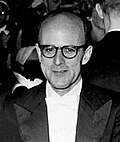
 United Kingdom of Great Britain and Northern Ireland
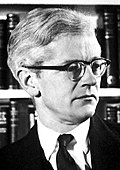
United Kingdom of Great Britain and Northern Ireland
Explanation
Our bodies are built from tiny parts called proteins. Each protein is folded up into a special shape, and that shape decides what it can do. In 1962, Mr. Perutz and Mr. Kendrew were the first to discover exactly what a protein looks like in three-dimensions. They shone invisible X-ray light on crystals of the proteins and used the star-shaped patterns that appeared to rebuild the protein’s shape like a puzzle. It is a bit like guessing an object’s form just by looking at its shadow. Thanks to their work, we can now understand illnesses better and design new medicines.
Related Keywords
X-ray crystallography
A method that shines X-rays on a crystal and calculates atomic positions from the diffraction pattern. Perutz and Kendrew were the first to apply it successfully to proteins. They solved the phase problem with isomorphous replacement and used Fourier transforms to build electron-density maps. Today, synchrotron and XFEL sources provide far higher resolution and speed. Structural data are essential for understanding enzyme mechanisms and optimising drug targets.
isomorphous replacement method
A technique that replaces some atoms in a crystal with electron-rich heavy atoms and derives phase information from differences in diffraction intensities. Perutz and colleagues attached Hg and Pt to protein crystals to obtain phases. Heavy-atom positions were found with difference Patterson maps, and multiple derivatives were combined to improve accuracy. The approach later evolved into single- and multi-wavelength anomalous dispersion methods. It remains a cornerstone for overcoming the phase problem in crystallography.
hemoglobin
A tetrameric protein (α2β2) in red blood cells that transports oxygen. Perutz’s analysis revealed its first low-resolution structure and laid the foundation for the cooperative oxygen-binding model. Four haem groups bind O2 reversibly and exhibit allosteric effects modulated by pH and CO2. Structural knowledge aids in understanding anaemic mutations and developing artificial blood substitutes. Hemoglobin remains a classic model for protein dynamics research.
myoglobin
A monomeric protein in muscle tissue that stores oxygen. Kendrew determined its 2.0 Å all-atom structure, revealing the first example of an α-helical bundle fold. The arrangement around the haem group allowed oxygen and carbon-monoxide binding properties to be explained at the molecular level. The structure serves as a benchmark for protein-folding studies and molecular dynamics simulations. Engineered myoglobin variants are now used in biosensing and synthetic biology.
structural biology
An interdisciplinary field that investigates the relationship between biomolecular 3-D structure and function using techniques such as X-ray crystallography, NMR and cryo-EM. The 1962 Nobel Prize in Chemistry marked its birth, and many later Nobel Prizes have come from the same area. Structural data, together with sequence information, form the foundation of modern life sciences and are indispensable for drug discovery, enzyme engineering and molecular evolution studies. Recent AI-based structure prediction (e.g., AlphaFold) is built upon this framework.
Fourier synthesis
A numerical method that uses diffraction amplitudes and phases to compute electron density. Perutz and Kendrew performed large-scale Fourier calculations with punched cards and early computers to obtain protein density maps. Today, FFT algorithms and GPUs allow the same task in seconds. Accuracy depends on B-factor correction and data completeness. The resulting density is iteratively updated during model building and refinement cycles.