1965 Nobel Prize in Chemistry
Reason for Award
for his outstanding achievements in the art of organic synthesis
Laureates
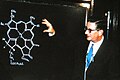
 United States of America
Explanation
Organic chemistry connects small pieces made of carbon into new substances. Dr. Woodward invented ways to assemble complex medicines and vitamins like building with LEGO bricks. Thanks to his work, important drugs that once existed only in nature can be produced in the laboratory. For example, he showed how to make quinine, a medicine against malaria, from simple chemicals. The medicines we take and the glues we use every day can now be manufactured safely and in large quantities because of this research. For chemists he was like an explorer who drew the first map of a new land.
Related Keywords
organic synthesis
Organic synthesis is the field that assembles carbon-based molecules via chemical reactions. It targets most substances vital to life, including natural products, pharmaceuticals and plastics. Chemists design the sequence of reactions that converts raw materials into the desired molecule and optimize reagents and conditions. Yield, selectivity and environmental impact are balanced while minimizing byproducts and stereochemical errors. Woodward brought both rigorous theory and artistic elegance to this discipline.
total synthesis of natural products
Total synthesis of natural products is the complete laboratory construction of complex molecules found in nature from inexpensive small molecules. It supplies pharmaceutical lead compounds and serves as a proof of molecular structure. Routes may involve dozens of steps, requiring protecting-group logic and stereoselective methods. Each success is regarded as a milestone that reflects the creativity and skill of chemists. Woodward redefined the limits of this art with syntheses of quinine, cholesterol and vitamin B12.
chlorophyll
Chlorophyll is the green pigment plants use to absorb light energy for photosynthesis. It features a tetrapyrrole framework coordinating a magnesium ion. Because the molecule is large and sensitive, chemical synthesis is challenging; Woodward’s partial syntheses advanced our understanding of its chemistry. The work contributed to the elucidation of photosynthetic mechanisms and to artificial light-harvesting materials. Chlorophyll remains a classic teaching example of complex macrocyclic synthesis.
quinine
Quinine is an alkaloid from cinchona bark long used to treat malaria. It contains two intricate rings and four stereocenters, making its total synthesis one of the great challenges of early 20th-century chemistry. Woodward reported the first successful synthesis in 1944, transforming concepts of synthetic strategy. The achievement paved the way for reliable drug supply and accelerated the development of stereochemical control methods. It remains a classic case study featured in textbooks.
vitamin B12
Vitamin B12 refers to a group of coenzymes essential for blood formation and neural maintenance in animals. It contains over 640 atoms in a corrin ring, making it extraordinarily complex. Woodward, collaborating with British chemist Albert Eschenmoser, completed its total synthesis in an international project of nearly 100 steps. This was the largest collaborative effort of its time and signaled the move of organic synthesis toward large-scale team science. The synthesis still serves as a technical benchmark for mega-size molecules.
synthetic strategy
Synthetic strategy refers to the guiding principles for designing a pathway to a target molecule. It integrates choice of starting materials, reaction order, protecting-group usage and stereochemical control. Woodward systematized retrosynthetic thinking, cutting molecules into functional blocks backward from the goal. Modern AI-assisted planning tools formalize this concept into algorithms. A sound strategy shortens step count, reduces waste and aligns with green-chemistry goals.
Woodward–Hoffmann rules
The Woodward–Hoffmann rules predict whether a pericyclic reaction is allowed or forbidden based on molecular-orbital symmetry. They quantitatively explain why thermal and photochemical conditions often reverse reaction feasibility. By grounding predictions in orbital interactions, the rules greatly increased the predictive power of synthetic design. They guide stereospecific additions and ring openings and find use in materials chemistry as well. The rules are a textbook example of a chemical ‘selection rule’.
stereoselectivity
Stereoselectivity is the tendency of a chemical reaction to produce one stereoisomer preferentially. It is crucial in pharmaceuticals because mirror-image forms often differ in efficacy or side effects. Woodward achieved high stereoselectivity through reagent choice and fine control of reaction conditions, pioneering routes to optically active compounds. His work laid the groundwork for later advances such as asymmetric catalysis and the Sharpless methods. Today, stereoselectivity is also valued for green chemistry and quality assurance.
reaction mechanism
A reaction mechanism depicts the step-by-step pathway by which a chemical reaction proceeds. It considers electron flow, transition states and energy barriers, aiding optimization of conditions. Woodward combined experimental observations with theoretical insights to propose mechanisms for complex reactions, streamlining synthesis. Understanding mechanisms is essential for route prediction and suppression of side reactions. Quantum-chemical calculations and machine learning now accelerate mechanistic studies.