1968 Nobel Prize in Chemistry
Reason for Award
for the discovery of the reciprocal relations bearing his name, which are fundamental for the thermodynamics of irreversible processes
Laureates
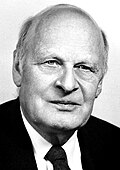
 United States of America,
  Norway
Explanation
When an ice cube melts, heat flows one way—from your warm hand into the cold ice. Scientists call such “one-way changes” irreversible. Dr. Onsager discovered a rule that tells how fast heat, electricity, or molecules move when something pushes them. His rule shows that the push and the flow are like mirror images that work both directions. Thanks to this idea, engineers can better design refrigerators, batteries, and even understand how salt and water move in our bodies. This clever discovery earned him the Nobel Prize in Chemistry.
Related Keywords
irreversible process
An irreversible process is a one-way change that will not spontaneously run backward in time. Classic examples include heat flowing from hot to cold objects and gas spreading throughout a container. During such processes entropy increases, and the second law demands that entropy production is always positive. Unlike reversible idealizations, irreversible processes involve friction or dissipation, converting useful energy partly into heat. Onsager’s theory supplies a quantitative framework for “near-equilibrium irreversible processes,” where departures from equilibrium are small. The framework underpins analyses in chemical engineering, biophysics, and countless other fields dealing with real dissipative systems.
Onsager reciprocal relations
The Onsager reciprocal relations state that, in the linear regime, the phenomenological coefficient matrix L is symmetric, i.e., L_ij = L_ji. Physically, the strength of a cross effect—such as heat driving an electric current—equals the strength of the inverse effect—electric current driving heat flow. Experimentally, this appears as the equality between Peltier and Seebeck coefficients at the same temperature. Microscopically it stems from detailed balance and time-reversal symmetry; violations indicate influences like magnetic fields or rotation. The symmetry halves the number of independent transport coefficients, reducing experimental workload in material research and process design. The relations also launched further developments such as linear response theory and the fluctuation–dissipation theorem.
entropy production
Entropy production quantifies the amount of entropy newly created when an irreversible process proceeds. In linear nonequilibrium thermodynamics it is written σ = Σ J_i X_i, the sum of products of each flux with its driving force. Positivity of σ embodies the second law, while σ = 0 corresponds to the reversible limit. In process engineering, lower entropy production means higher energy efficiency of equipment. In living organisms, ATP-powered chemical pumps regulate entropy production to sustain order. Onsager’s theory expresses σ as a quadratic form, providing the mathematical basis for the principle of minimum entropy production.
thermodynamic force
A thermodynamic force X_i quantifies a gradient or difference that drives a flow, e.g., the temperature gradient −∇T/T or a chemical potential difference Δμ/T. In Onsager’s flux–force formalism, each flux J_i is paired with a unique thermodynamic force. The forces directly enter the expression for entropy production and determine the direction and magnitude of the flows. When cross effects are present, several forces influence the same flux, making the coupling coefficients L_ij essential. Experimentally, researchers impose a thermodynamic force as a control variable and measure the resulting flux to obtain transport coefficients. Microscopically, the force performs work on particles via macroscopic energy gradients, generating motion.
flux
A flux J_i denotes the amount of some physical quantity (matter, energy, charge, etc.) passing through a unit area per unit time. Examples include heat flux q, mass flux J, and electric current density j. In the linear regime a flux is proportional to its driving force, with the proportionality constant being a transport coefficient. Onsager’s theory revealed that different kinds of fluxes can be symmetrically coupled by cross coefficients. The thermoelectric effect, where a temperature gradient generates an electric current, exemplifies interaction between heat flux and charge flux. Accurate definition of flux is essential for matching statistical-mechanical averages with experimental or simulation measurements.
transport coefficient
A transport coefficient is the proportionality constant between a flux and its driving thermodynamic force; examples are thermal conductivity, diffusion coefficient, and electrical conductivity. These coefficients depend on material type, temperature, pressure, and serve as fundamental data for material selection and process design. Onsager reciprocity reduces the number of independent transport coefficients thanks to the symmetry of the L matrix. Green–Kubo relations allow calculation of transport coefficients from time correlation functions in molecular dynamics simulations. In nanomaterials, size effects cause significant deviations from bulk values, demanding accurate measurement and theory. Developing high-performance thermoelectric materials requires optimizing conflicting transport coefficients: low thermal conductivity and high electrical conductivity.
linear response theory
Linear response theory approximates a system’s reaction to a small external perturbation by retaining terms only up to first order in the perturbation. Onsager’s work laid the groundwork, later extended to quantum statistical systems by Kubo’s formula. The response function connects energy dissipation to fluctuation correlations, expressed in the fluctuation–dissipation theorem. Measurements of electrical conductivity, optical transmittance, and many other material properties are evaluated within the linear response framework. Determining the range where nonlinear effects are negligible makes experiment–theory comparisons straightforward. Under strong perturbations such as ultrafast lasers or intense electric fields, deviations from linear response become signatures of novel phenomena.
fluctuation-dissipation theorem
The fluctuation-dissipation theorem (FDT) states that the magnitude of a system’s spontaneous equilibrium fluctuations equals its linear response to an external perturbation. Therefore response functions can be computed solely from equilibrium correlation functions, greatly simplifying experiments and simulations. Onsager reciprocity is viewed as a classical precursor to the FDT, marking an essential step in building the theory. Phenomena ranging from Johnson noise in electrical circuits to viscoelasticity of complex fluids are unified under the FDT. In nonequilibrium situations such as contacts at different temperatures, FDT is violated, and the degree of violation reveals new physics. Recent work extends FDT to active matter and glassy systems far from equilibrium.