1975 Nobel Prize in Chemistry(1)
Reason for Award
for his work on the stereochemistry of enzyme-catalyzed reactions
Laureates
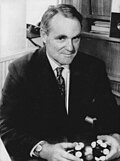
 Australia,
  United Kingdom of Great Britain and Northern Ireland
Explanation
Inside our bodies, tiny helpers called enzymes cut and glue molecules together. Molecules can be like right-hand and left-hand gloves, and mismatched shapes do not fit. Dr. Cornforth studied which hand an enzyme chooses during a reaction. By finding out from which side the building blocks are added, scientists learned how to gather only the “right hand” molecules for medicines. Thanks to this, drugs can now be safer and work better.
Related Keywords
stereochemistry
Stereochemistry is the branch of chemistry that deals with how atoms are arranged in three-dimensional space. It distinguishes chiral molecules that are mirror images, like right and left hands. It also explains the ratio of isomers produced by a reaction pathway. In pharmaceuticals, stereochemistry strongly influences efficacy and side effects. Enzymes are natural catalysts that exert exquisite stereochemical control.
enzyme catalysis
Proteins or ribozymes lower activation energy and greatly accelerate reactions. The substrate-binding pocket is selective not only in shape but also in stereochemistry. Catalytic residues act as acids, bases or nucleophiles, and metal cofactors often assist electron transfer. Cornforth’s work showed from which side enzymes add or remove hydrogens or methyl groups. This knowledge has accelerated the design of artificial enzymes and biotransformation technologies.
chirality
Chirality is the property of an object that cannot be superimposed on its mirror image, like hands or screws. A chiral molecule exists as two enantiomers that lack internal symmetry. Enzymes in living organisms usually recognize only one enantiomer. The wrong mirror image can cause serious drug side effects. Cornforth experimentally demonstrated how enzymes discriminate chirality.
isotopic labeling
Isotopic labeling introduces stable isotopes such as 13C or deuterium into defined positions of a molecule. Because these isotopes can be traced by NMR or mass spectrometry, the method is indispensable for elucidating reaction mechanisms. In stereochemical studies, it proves from which face an atom participates. Cornforth was the first to apply large-scale isotopic labeling to biosynthetic analysis. Today it is extended to metabolic flux analysis and PET imaging.
enantioselectivity
Enantioselectivity measures how much a reaction favors one mirror image over the other. The theoretical maximum is 100% ee, and pharmaceuticals often require above 90%. Enzymes naturally display high enantioselectivity and are prized in green chemistry. Cornforth’s analyses clarified that the origin of selectivity lies in steric effects in the transition state. This became a guiding principle for designing asymmetric catalysts.
biosynthesis
Biosynthesis is the sequence of enzyme-mediated reactions that organisms use to build complex natural products, such as cholesterol or antibiotics. Stereochemistry governs the direction and selectivity of the entire pathway. Cornforth was the first to trace in detail the cyclizations and rearrangements in steroid biosynthesis. His results underpin modern natural-product chemistry and metabolic engineering.