1983 Nobel Prize in Chemistry
Reason for Award
for his work on the mechanisms of electron transfer reactions, especially in metal complexes
Laureates
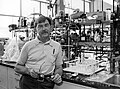
 United States of America
Explanation
In our bodies and in batteries, tiny particles called electrons move back and forth carrying energy. Dr. Taube studied molecules that have a metal atom at the center—these are called metal complexes—to find out where the electrons go and which path they take. It is like figuring out whether friends pass a ball directly by hand or send it along a string. Thanks to his work, we understand batteries and photosynthesis better, and we can design new materials and medicines.
Related Keywords
electron transfer reaction
The process in a redox reaction where an electron moves from a donor to an acceptor. Both kinetic parameters and thermodynamic driving force matter, and the phenomenon is essential in energy conversion and life processes.
metal complex
A chemical species in which a central metal ion is surrounded by molecules or ions called ligands. Coordination number, ligand-field strength, and electron configuration strongly influence its reactivity.
outer-sphere electron transfer
A pathway in which two complexes exchange an electron while keeping their coordination spheres intact. Reorganization energy and Coulombic interactions control the rate and are described by Marcus theory.
inner-sphere electron transfer
A pathway where two complexes share a bridging ligand to form a transient covalent link through which the electron travels. The nature of the bridge strongly affects the reaction rate.
coordination chemistry
The branch of chemistry that studies how metal ions bind to ligands and how these complexes react. It underpins applications in catalysis, medicine, and materials science.
chemical kinetics
The study of how fast chemical reactions proceed and how rate depends on temperature, catalysts, and structure. It is indispensable for analyzing electron-transfer reactions.
Marcus theory
A theory that derives the activation energy of outer-sphere electron transfer from solvent and inner reorganization energies. It depicts the relationship between reaction rate and free-energy change as a parabola.
redox reaction
A chemical reaction in which oxidation states change due to electron transfer. It forms the basis of diverse phenomena such as energy conversion, corrosion, and metabolism.