1994 Nobel Prize in Chemistry
Reason for Award
for his contribution to carbocation chemistry
Laureates
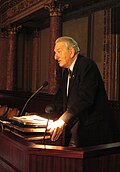
 United States of America,
  Hungary
Explanation
Everyday products such as plastics and gasoline are made of tiny particles called molecules. George Olah discovered a way to watch a very elusive kind of molecule fragment called a “carbocation,” a carbon atom carrying extra positive charge. Catching it is like gently grabbing a restless soap bubble and taking its picture. He used an ultra-strong “superacid” to calm the carbocation long enough to study it. What he learned helps scientists create cleaner fuels and useful new materials.
Related Keywords
carbocation
An organic ion featuring a positively charged carbon center. It is a crucial but normally fleeting intermediate in many organic reactions.
superacid
Acids far stronger than sulfuric acid, exhibiting extremely high protonating power. They stabilize carbocations and enable unconventional protonation chemistry.
magic acid
A mixture of fluorosulfuric acid and antimony pentafluoride. A prototypical superacid capable of generating and holding numerous carbocations at room temperature.
SN1 reaction
A nucleophilic substitution mechanism in which a leaving group departs first to form a carbocation, followed by attack of a nucleophile in a second step.
methanol economy
A concept proposed by Olah that envisions synthesizing methanol from CO2 and renewable hydrogen and recycling it as both fuel and chemical feedstock.
nonclassical cation
Carbocations such as the 2-norbornyl ion whose positive charge is delocalized over a bridged framework involving more than one carbon atom.
petroleum cracking catalyst
Industrial catalysts that break long-chain hydrocarbons into shorter gasoline-range molecules; their design relies on carbocation reaction pathways.