1969 Nobel Prize in Literature
Reason for Award
for his writing, which – in new forms for the novel and drama – in the destitution of modern man acquires its elevation
Laureates
 Ireland
Explanation
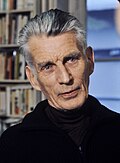
Samuel Beckett was a writer who talked about feelings that do not go well for people, using stories and plays. In his famous play “Waiting for Godot,” two people wait for someone who never comes. It seems like nothing happens, yet we learn a lot about how people feel during that time. Beckett’s words are short and almost picture-book simple. But inside them are many important questions. That is why people all over the world still read and perform his works today.
Related Keywords
Theatre of the Absurd
A mid-20th-century theatrical movement that deliberately lacks logical plot or clear purpose to express the anxiety and isolation of modern people. Influenced by Sartrean and Camusian existentialism, it exposes the meaninglessness of language. Beckett, Ionesco, and Adamov are key figures. Dialogue relies on repetition and silence, giving audiences both unease and dark humor. The style spread into visual arts and cinema, reflecting post-war cultural trauma.
Waiting for Godot
Premiered in 1953, it is Beckett’s signature play. Two tramps, Vladimir and Estragon, keep waiting for someone named “Godot,” who never appears. The action unfolds on an almost bare stage with a single leafless tree. Indeterminate action and cyclical time symbolize the emptiness of human existence. The play is performed worldwide and often cited as a metaphor for “waiting” under political oppression or during disasters.
Existentialism
A 20th-century philosophical movement focusing on individual freedom, choice, and the feelings of anxiety or nothingness. It originated with Kierkegaard and Nietzsche and was further developed by Sartre and Camus. Although Beckett does not explicitly discuss philosophy, his works raise existential questions through the impossibility of decisive action or choice. Characters search for meaning and usually fail to find it. This structure forces readers and viewers to generate meaning themselves.
Minimalism
An artistic approach that reduces expression to the bare minimum. Beckett’s stagecraft strips props and dialogue to the extreme, making space and silence active elements. By “reading” what is absent, audiences’ imagination is heightened. Parallel developments appear in 1960s music and architecture minimalism. Emphasizing blankness brings the conceptual aspects of the work to the forefront.
Limits of language
Following Wittgenstein’s insight, there exists a domain where words cannot reach. Through silence and repetition, Beckett shows that language both conveys meaning and reveals its own limits. Structures in which characters speak but never reach the core anticipate modern communication breakdowns. Scholars see this as a bridge to post-structuralism and deconstruction. It advances metalinguistic self-reflection in literature.
Post-war literature
A literary movement that emerged after World War II, portraying the shaken value systems born of destruction and loss. Beckett seldom depicts war directly, yet his absurdity and sense of emptiness reflect Europe’s post-war mental landscape. Ephemerality, corporeality, and a lack of historical continuity appear as shared motifs. Experimental technique and self-reference mark the transition from modernism to post-modernism. Through translation and performance, his work influenced other national post-war literatures.