1910 Nobel Prize in Physics
Reason for Award
for his work on the equation of state for gases and liquids
Laureates
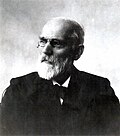
 Netherlands
Explanation
Air and water are made of tiny particles called molecules. Mr. van der Waals thought about how these molecules pull and bump each other and created a formula that explains how gases and liquids behave. With his formula you can calculate how hard the air pushes back when you blow up a balloon. It also tells us why warm water turns into steam and why steam becomes water again when it cools. This idea is used in refrigerators and weather prediction today. His work let us understand the unseen world around us with numbers—an amazing discovery.
Related Keywords
equation of state
A mathematical relation connecting pressure, volume, temperature and other variables of a substance. It is a fundamental tool for calculating thermodynamic properties of gases, liquids and solids. The van der Waals equation was the first to address real fluids, giving it historical significance. Industrially, equations of state are used to design gas mixtures and predict phase equilibria. They are also indispensable in astrophysics and high-pressure science.
van der Waals forces
A collective term for weak attractive and repulsive interactions between molecules. Includes induced-dipole interactions and London dispersion forces. They underlie phenomena such as liquid cohesion and protein folding. The “a” parameter in the van der Waals equation represents an average of these forces. They are crucial design considerations in nanotechnology and materials science.
critical point
The temperature and pressure at which the distinction between gas and liquid disappears. At this point the density difference between phases becomes zero and no phase boundary exists. Van der Waals calculated critical coefficients theoretically, introducing the idea of universality. Near the critical point, fluctuations diverge and critical phenomena appear. Engineering applications, such as supercritical CO2 turbines for power generation, are rapidly expanding.
intermolecular interaction
A collective term for forces and energies exchanged between molecules, including electrostatic, induction, dispersion and short-range repulsion. They cause non-ideality in gases and determine viscosity and surface tension in liquids. Van der Waals’ work was the first step in capturing these interactions through macroscopic parameters. Today, quantum-chemical calculations provide detailed potential energy surfaces, enabling precise material design.
principle of continuity
The idea that gas and liquid are essentially the same state of matter and can transform into each other smoothly. By adjusting temperature and pressure, a gas changes continuously into a liquid and the boundary vanishes at the critical point. The van der Waals equation provided a mathematical underpinning for this principle. It deepened understanding of phase diagrams and laid the groundwork for supercritical fluid research. Applications have grown in food extraction and green chemistry.
liquefaction
The process of turning a gas into a liquid by cooling or compressing it. Air liquefaction enabled mass production of medical oxygen and rocket propellants. Van der Waals’ theory guided the design of liquefaction conditions. Today it is indispensable for refrigeration cycles and LNG transport. Research on CO2 liquefaction is advancing for greenhouse gas mitigation.
ideal gas
A hypothetical gas model that assumes molecules have no volume and no forces between them. Described by the simple equation PV = nRT. Real gases approach ideal behavior at low pressure and high temperature but deviate at higher densities. The van der Waals equation was proposed to explain these deviations. The ideal gas model remains an essential introductory concept in thermodynamics.