1911 Nobel Prize in Physics
Reason for Award
for his discoveries regarding the laws governing the radiation of heat
Laureates
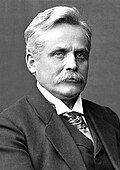
 German Empire
Explanation
When you stand near a warm stove you feel heat even though it is not glowing red. That heat is invisible light called infrared radiation. Wilhelm Wien carefully studied how the colour of the light coming from a hot object depends on its temperature. He found a rule that says "the hotter the object, the more the light shifts toward blue, the cooler, toward red," and wrote it as a formula. Using this rule we can tell the surface temperature of a lump of iron or a distant star just by looking at its colour. This is why astronomers can measure the temperatures of stars far away in space.
Related Keywords
thermal radiation
Thermal radiation is the process by which any object with temperature emits part of its internal energy as electromagnetic waves. The hotter the object, the more energy it radiates and the shorter the peak wavelength becomes. The red glow of a campfire and the infrared LED in a remote control are both manifestations of thermal radiation. Because it propagates through vacuum, thermal radiation is essential for energy transfer in space and for calculating Earth’s radiation balance. Studies of black-body thermal radiation provided the historical trigger for the birth of quantum mechanics.
Wien's displacement law
Wien’s displacement law is expressed as λ_max T = b, where b ≈ 2.898 × 10⁻³ m·K. It states that the wavelength λ_max at which a black-body spectrum peaks is inversely proportional to the temperature T. The rule allows astronomers to estimate the temperature of distant stars simply by measuring their colour or spectrum. It is also applied in industrial pyrometers and molten-steel control, providing instant temperature readings through optics. Physically, the law is obtained from the derivative condition of the energy distribution and reflects the universal nature of the Planck spectrum.
blackbody
A blackbody is an ideal object that absorbs all incident electromagnetic radiation and, in thermal equilibrium, re-emits it perfectly. Although no perfect blackbody exists, graphite powders and cavity furnaces approximate one closely. The black-body spectrum depends only on temperature, exhibiting universality independent of material composition. This property makes it the reference model for sunlight, stellar spectra and many calculations in astronomy and climate science. Planck’s introduction of the quantum hypothesis to explain black-body radiation marked a turning point in the history of physics.
Planck distribution
The Planck distribution, u_ν = (8πhν³/c³)/(e^{hν/kT} − 1), gives the complete spectrum of black-body radiation. At short wavelengths it approaches Wien’s exponential law, while at long wavelengths it reduces to the Rayleigh–Jeans ν² behaviour. Planck introduced the energy quantum ε = hν to overcome the experimental limits of Wien’s law. The formula was the first triumph of quantum statistics and became the prototype for the Bose occupancy distribution. Its derivation influenced diverse areas, from specific heats of solids and the photoelectric effect to modern laser physics.
high-frequency limit
In the high-frequency limit of a black-body spectrum, ν → ∞ or λ → 0, the energy density decays exponentially. This region is where the Wien approximation is accurate because photon energies greatly exceed kT. It is experimentally observed in the ultraviolet and soft X-ray bands and is used to diagnose solar coronae and fusion plasmas. Statistically, the Bose occupation number is governed by e^{−hν/kT}, leaving only the exponential term of the Planck distribution. The limit is applied in analyses of the high-frequency tail of the cosmic microwave background and in the thermal components of gamma-ray bursts.
temperature
Temperature is the physical quantity describing the thermal state of matter and is related to the average kinetic energy of its particles. In black-body radiation, temperature is the sole parameter that entirely determines the shape and intensity of the spectrum. Wien’s displacement law and the Planck distribution enabled the development of "radiative thermometry," allowing temperature estimation remotely through optics. In astronomy, effective temperature of stars and planets is a fundamental parameter for classifying luminosity and evolutionary stage. In high-energy physics and cosmology, the temperature history of the early universe governs nucleosynthesis and structure formation.
electromagnetic spectrum
The electromagnetic spectrum spans a continuous range of wavelengths or frequencies from gamma rays to radio waves. Thermal radiation occupies part of this spectrum, with its peak shifting through infrared, visible and ultraviolet bands depending on temperature. Wien’s work linked spectral wavelength distributions to energy density, laying the foundation for optical diagnostics. Modern spectroscopy explores different physical processes across the spectrum, from molecular vibrations and rotations to the cosmic microwave background. Spectral analysis is indispensable in many areas of science and industry, including medical diagnostics, communication technology and environmental monitoring.