1918 Nobel Prize in Physics
Reason for Award
for the services he rendered to the advancement of Physics by his discovery of energy quanta (Annalen der Physik 1 (1900) 719; 4 (1901) 553)
Laureates
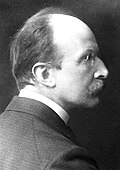
 German Empire
Explanation
The light and heat around us can be thought of as made of tiny "grains." In 1900, Max Planck called these grains "energy quanta" and suggested that light’s energy is not continuous but comes in small packets. It is like paying money only with one-yen coins: you cannot split the coin into smaller pieces, and energy, too, is exchanged in indivisible amounts. His idea explained the changing colors of a heated iron (blackbody radiation), which older theories could not. This discovery opened the door to quantum physics, leading much later to technologies such as TVs, computers, and LEDs.
Related Keywords
energy quantum
The concept introduced by Planck that energy is exchanged in discrete, minimal units rather than continuously. Light or an oscillator of frequency ν may possess only integer multiples of the energy hν. This assumption allowed the theoretical blackbody spectrum to coincide exactly with experimental data. Energy quanta were later linked to the particle-like “photon” picture by Einstein. Today they form the basic unit for explaining electron transitions, phonon excitations, qubit manipulations, and many other phenomena.
blackbody radiation
A blackbody is an ideal object that absorbs all incident light and, in thermal equilibrium, emits a characteristic spectrum of radiation. Classical mechanics predicted an infinite energy output at high frequencies—a dilemma known as the ultraviolet catastrophe. Planck’s quantum hypothesis resolved this mismatch and reproduced the measured curve precisely. Blackbody radiation serves as a basic model for stars and the cosmic microwave background in astrophysics. It is also fundamental in engineering applications such as thermal radiometry and infrared sensor design.
Planck constant
The proportionality constant h ≈ 6.626×10^−34 J·s that appears in Planck’s quantization rule. It is a quantum of action linking energy with frequency and momentum with wavelength. It features in relations such as de Broglie’s p = h/λ and Heisenberg’s uncertainty principle ΔxΔp ≥ h/4π. In the 2019 redefinition of the SI base units, h was fixed to an exact value, providing the new standard for the kilogram. The constant continues to set scale limits in quantum computing gate speeds and fundamental noise levels in cutting-edge research.
ultraviolet catastrophe
The divergence to infinite energy in the high-frequency region predicted by the classical Rayleigh–Jeans theory of blackbody radiation. Experiments showed finite energy with a peak, contradicting the classical prediction. The catastrophe served as decisive evidence for the breakdown of the assumption of continuous energy. Planck’s quantum hypothesis suppressed the divergence and produced a spectrum consistent with observations. Today it is a historical lesson illustrating the limits of classical statistical mechanics and is frequently cited in physics education.
quantization
The principle that certain physical quantities take on discrete rather than continuous values. Planck proposed energy quantization, and Bohr later introduced quantized angular momentum. Quantization is fundamental in eigenvalue problems of the Schrödinger equation and in solid-state band structures. Although the macroscopic world appears continuous, countless experiments confirm that quantization dominates at very small scales. The concept underlies precision measurement technologies such as SQUIDs and the integer steps of the quantum Hall effect.
Boltzmann constant
The fundamental constant of statistical mechanics k_B ≈ 1.380649×10^−23 J/K. It links the temperature scale to energy and appears in calculations of average energies. In Planck’s derivation the mean energy ⟨E⟩ = hν/[exp(hν/kT) − 1] includes k_B. The 2019 SI redefinition also fixed the value of k_B, forming the basis of the kelvin. It is indispensable in thermal noise (Johnson noise) and in the entropy expression of probabilistic information theory.
Planck's law
The formula for the energy density of blackbody radiation: I(ν,T) = (2hν^3/c^2)/(e^{hν/kT}−1). It approaches the Rayleigh–Jeans law at low frequency and Wien’s law at high frequency, ensuring continuity. Its perfect agreement with experiments was the first major success of the quantum hypothesis. Observations of the cosmic microwave background show that the law holds on a cosmological scale. In engineering it is essential for infrared radiometry, thermal sensor calibration, and related measurements.