1922 Nobel Prize in Physics
Reason for Award
for his services in the investigation of the structure of atoms and of the radiation emanating from them
Laureates
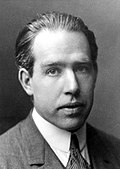
 Denmark
Explanation
All the things around us are made of tiny particles called atoms. Niels Bohr imagined each atom like a miniature solar system where electrons circle the nucleus. He said electrons cannot move wherever they like; they must stay on special fixed paths. When an electron jumps from one path to another, it gives off or takes in light. This idea helps us understand why fluorescent lamps shine and why fireworks show different colors. So Bohr’s work is closely linked to the lights and colors we see in everyday life.
Related Keywords
Bohr model
The Bohr model is an early quantum atomic model that assumes electrons revolve in circular orbits around the nucleus with quantized angular momentum. This assumption leads to discrete, rather than continuous, energy values for the electron. It was the first theory to derive the Rydberg formula for the spectral lines of hydrogen from fundamental principles. Although it is a hybrid of classical mechanics and quantum postulates and thus incomplete, it succinctly explains many empirical facts. The model was later superseded by wave mechanics, yet its visual clarity keeps it in modern textbooks. It remains useful for rough estimates of atomic sizes and ionization energies, playing an important educational role in physics and chemistry.
quantum hypothesis
The quantum hypothesis, introduced by Max Planck to explain black-body radiation, states that energy is exchanged in discrete packets called quanta. Bohr applied this idea to electrons in atoms, legitimizing the discretization of energy levels. According to the hypothesis, when an electron transitions between allowed orbits it emits or absorbs a photon whose energy equals the level difference. The concept was later expanded by Heisenberg, Schrödinger and others into the full theory of quantum mechanics. Today, technologies such as lasers, semiconductors and MRI scanners fundamentally rely on the quantum hypothesis.
spectral lines
Spectral lines are bright or dark features at specific wavelengths that appear when atoms or molecules emit or absorb light. The Balmer and Lyman series in hydrogen spectra correspond to energy differences between electron levels. The Bohr model formalized these series using the Rydberg constant and quantum numbers, matching observed wavelengths with high accuracy. Spectral-line analysis is indispensable for identifying elements, measuring stellar temperatures and evaluating galactic redshifts. It also underpins plasma diagnostics and laser spectroscopy, supporting advances in industry and medicine. Precise measurements of line shapes and widths are crucial for testing quantum electrodynamics and determining fundamental constants.
energy level
An energy level is a discrete value of energy permitted to a particle in quantum theory. Electrons can occupy only these specific levels; they cannot vary their energy continuously. The colors and intensities of atomic spectra are governed by transitions between levels. Energy levels are applied to solid-state band structures, laser-medium design and determining NMR frequencies. Bohr’s work was the first to clearly demonstrate this discreteness, shaping the core of quantum mechanics.
Rydberg constant
The Rydberg constant is a fundamental value appearing in the formula for hydrogen spectral wavenumbers, approximately 1.097×10^7 m^-1. The Bohr model successfully derived this constant from the electron mass, elementary charge and vacuum permittivity. Its precise measurement serves to test atomic theory and the interrelation of fundamental physical constants. The name also persists in studies of Rydberg atoms (highly excited atoms), a hot topic in quantum information science. Through QED corrections and mass-ratio effects, the constant is employed to test cutting-edge theories.
hydrogen atom
The hydrogen atom, composed of a single proton and a single electron, is the simplest atom in the universe. Its simplicity makes it the best testbed for comparing theory and experiment. The Bohr model was first applied to hydrogen spectra, supporting the existence of discrete energy levels. In later quantum mechanics, the hydrogen atom remains one of the few problems with an analytic Schrödinger-equation solution. Precision spectroscopy of hydrogen helps determine the fine-structure constant and the electron mass, underpinning international agreements on physical constants. In cosmology, hydrogen data are indispensable for studying the recombination era and absorption lines from high-redshift objects.