1926 Nobel Prize in Physics
Reason for Award
for his work on the discontinuous structure of matter, and especially for his discovery of sedimentation equilibrium (Ann. de Chim. et de Phys., 8th series, 18 (1909) 5-114)
Laureates
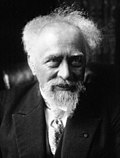
 France
Explanation
Everything you see—water in a glass or the air you breathe—is made of tiny pieces called molecules. A hundred years ago, some people were not sure those molecules were real. Jean Perrin put very small colored grains into water and watched them through a magnifying glass to see how they spread from bottom to top. Gravity tries to pull the grains down, but invisible pushes from molecules kick some of them back up, so a few stay higher. By counting how many grains appear at each height, he found a rule that only makes sense if molecules exist. In this way, he showed in a visible way that matter really is made of tiny building blocks.
Related Keywords
sedimentation equilibrium
Sedimentation equilibrium describes the balance between a particle’s tendency to sink under gravity and the tendency to spread upward by thermal diffusion. The particle concentration decreases exponentially with height, and the decay constant contains Boltzmann’s constant. Demonstrating that solid particles obey the same statistical mechanics as gas molecules, it provided a crucial test of molecular theory. Perrin measured the profile directly with a microscope and offered an independent route to Avogadro’s constant. The concept is now applied in analytical ultracentrifugation and protein molecular-weight determination.
Brownian motion
Brownian motion is the irregular zig-zag movement of small particles suspended in water or air. Discovered by Robert Brown in 1827 and given a theoretical explanation by Einstein in 1905, the mean-square displacement of a particle grows linearly with time, yielding a diffusion coefficient D. Perrin experimentally confirmed this relation and measured its dependence on temperature and viscosity. Quantifying Brownian motion links statistical mechanics directly to experiment and underpins our understanding of transport phenomena at the nanoscale.
Avogadro constant
The Avogadro constant is the number of particles in one mole, about 6.022×10²³. It equals the ratio R/k_B of the gas constant to Boltzmann’s constant. While 19th-century estimates came from gas diffusion and electrolysis, Perrin obtained an independent value from liquid-phase sedimentation equilibrium and Brownian motion. Agreement among methods became a strong argument for atomic theory and improved the precision of chemical stoichiometry. Today, ever more accurate determinations, e.g., counting atoms in silicon spheres, are tied to the redefinition of the kilogram.
colloidal particles
Colloidal particles are tiny entities 1 nm to 1 µm in diameter dispersed in a liquid or gas. They scatter light and make solutions appear cloudy, yet do not quickly settle under gravity. In Perrin’s work they served as visible probes, allowing molecular-level statistical laws to be tested at a mesoscopic scale. Today they are used in paints, foods, drugs, and electronic inks, and by tuning inter-particle forces they can gel or self-assemble. Colloid science is a central branch of soft-matter physics.
discrete nature of molecules
The discrete nature of molecules states that matter is composed of finite-sized particles rather than a continuous substance. Because 19th-century thermodynamics could be developed with continuum models, some scientists doubted the existence of atoms. Perrin’s concentration-profile measurements directly tested equations containing the discrete energy unit k_BT and produced results incompatible with a purely continuous model. Consequently, the physical reality of atoms and molecules was largely settled. The later rise of quantum mechanics built upon that acceptance of discreteness.
light scattering method
Light scattering analyzes particle size, shape, and interactions from the intensity pattern produced when light encounters molecules or particles. It is grounded in Rayleigh and Mie theories. Perrin’s colloid work pioneered visible-light scattering observation, later extended to Debye’s dynamic light scattering. Applications include protein molecular-weight determination, polymer chain-length estimation, and nanoparticle aggregation studies. Advances in optics now allow sub-microsecond time resolution.
buoyancy
Buoyancy is the upward force exerted on a body immersed in a fluid. By Archimedes’ principle it equals the weight of the displaced fluid. In Perrin’s analysis the effective mass m_b=m−ρ_fluid V governs sedimentation, requiring precise buoyancy corrections to obtain accurate concentration profiles. The concept is vital from balloon flight to deep-sea vehicle design. Even at microscopic scales, the competition between buoyancy and thermal fluctuations controls colloid stability.