1938 Nobel Prize in Physics
Reason for Award
for his demonstrations of the existence of new radioactive elements produced by neutron irradiation, and for his related discovery of nuclear reactions brought about by slow (thermal) neutrons
Laureates
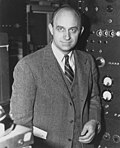
 Kingdom of Italy
Explanation
1. Atoms are like tiny marbles that make up everything. 2. Mr. Fermi shot even tinier particles called neutrons at these atoms. 3. The atoms changed into new kinds of atoms and started giving off invisible rays. 4. He found that slow-moving neutrons, called thermal neutrons, make the change happen more easily than fast ones. 5. This idea later helped doctors create medical tracers and engineers build nuclear power stations. 6. Imagine gently pressing soft clay onto another piece so they stick together; smash it too hard and the pieces just scatter—that is the difference slow neutrons make.
Related Keywords
thermal neutron
A thermal neutron possesses kinetic energy of about 0.025 eV, corresponding to room-temperature motion. It is produced when fast neutrons collide repeatedly with hydrogen-rich materials such as water or paraffin and lose energy. The lower relative velocity and longer de Broglie wavelength give thermal neutrons a much larger nuclear capture cross-section. Fermi exploited this property to boost reactions that rarely occur with fast neutrons. In reactors, the free-path length and energy spectrum of thermal neutrons are finely tuned to achieve criticality. Modern applications include medical radioisotope production and neutron radiography.
radioisotope
A radioisotope is an unstable nuclide of an element that emits radiation and transforms into another nucleus over time. Fermi synthesized more than 30 new isotopes by neutron irradiation and measured their half-lives and decay modes. Artificial isotopes evolved into tracer tools for tracking processes in the body or in materials. Iodine-131, for example, is employed for thyroid diagnostics and therapy, while cobalt-60 serves in cancer radiotherapy. Industrial uses include thickness gauges and leak detection, all requiring precise dosimetry for safety.
neutron capture cross-section
The neutron capture cross-section, measured in barns (1 barn = 10⁻²⁴ cm²), quantifies the ‘target size’ a nucleus presents to an incoming neutron. A larger value means the neutron is more likely to be absorbed. Fermi demonstrated that cross-sections often rise inversely with neutron velocity, reaching thousands of barns for silver in the thermal range. Reactor design balances the fission cross-section of fuel (e.g., 235U) against the capture cross-section of poisons (e.g., 135Xe) to maintain criticality. Calculations of cosmogenic nuclides and strategies for transmuting nuclear waste also rely on accurate cross-section data.
nuclear fission
Nuclear fission occurs when a heavy nucleus splits into two or more lighter nuclei, releasing a large amount of energy and typically two or three neutrons. Fermi’s thermal-neutron studies paved the way for Hahn and Strassmann’s uranium fission experiment. If the emitted neutrons trigger further fissions, a chain reaction results, enabling continuous energy extraction. With control rods and coolant the reaction forms a power reactor; without control it becomes a weapon. Fission yields over a million times the heat of burning 1 g of coal, linking it to both energy solutions and security concerns.
chain reaction
A chain reaction is a process in which a product of one reaction initiates subsequent identical reactions, leading to a self-amplifying sequence. In fission, the neutrons released act as triggers for further splits. Denoting the average multiplication factor per generation as k, the reaction grows exponentially for k > 1, stays steady for k = 1, and dies out for k < 1. Fermi and Szilard calculated how to reach k = 1 and achieved the first critical experiment, Chicago Pile-1. Similar positive-feedback structures appear in chemistry and ecology, making chain reactions a key concept in control theory and risk assessment.
neutron moderator
A neutron moderator is a material that slows fast neutrons to thermal energies through repeated elastic scattering. Water, heavy water, and graphite—materials with light nuclei—are effective; selection depends on the average energy loss per collision (ξ) and the absorption cross-section Σₐ. Fermi demonstrated moderation with paraffin and later proposed graphite as the main moderator in reactor cores. A suitable moderator increases the multiplication factor k, whereas excessive absorption lowers it, making purity control vital. In modern light-water reactors the primary coolant doubles as moderator, linking criticality control with heat removal.