1951 Nobel Prize in Physics
Reason for Award
for their pioneer work on the transmutation of atomic nuclei by artificially accelerated atomic particles
Laureates
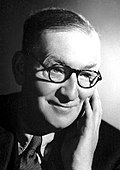
 United Kingdom of Great Britain and Northern Ireland
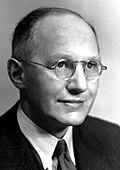
 Ireland
Explanation
Everything around us is made of tiny building blocks called atoms. Sir John Cockcroft and Ernest Walton managed to change the nucleus at the center of an atom by shooting another tiny particle, a proton, at it. Think of it like flicking a fast marble in a pinball machine so hard that the target breaks and becomes something new. They built a special machine that made the proton incredibly fast, and thanks to that they were the first to turn one element into another by human hands. Their success became the starting point for today’s huge particle accelerators.
Related Keywords
nuclear transmutation
The phenomenon in which the nucleus of one element is converted into that of another through a nuclear reaction. While it occurs naturally in cosmic rays and radioactive decay, Cockcroft and Walton achieved it artificially for the first time, enabling precise energy measurements of nuclear reactions and the synthesis of new isotopes.
particle accelerator
A device that accelerates charged particles using electric and magnetic fields so they can collide at high energy. The Cockcroft–Walton type is one of the earliest high-voltage DC accelerators and can be considered an ancestor of today’s large circular and linear machines.
Cockcroft–Walton circuit
A power-supply circuit that links diodes and capacitors in a ladder configuration, rectifying and multiplying AC to produce high DC voltage. It is electrically simple, supports relatively high current, and is still used in medical X-ray machines and as high-voltage sources for hadron accelerators.
lithium-7
A stable isotope used as the target in the proton-bombardment experiment. The 7Li + p reaction yields two α-particles and 17.2 MeV of energy, historically famous for confirming E = mc².
proton
The positively charged particle that makes up a hydrogen nucleus. Cockcroft and Walton accelerated protons to several hundred keV and used them as probes in nuclear reactions.
high-voltage direct current (HVDC)
Direct current electricity at voltages of hundreds of kilovolts or more. In accelerators it is indispensable for imparting large energy to charged particles in a single stage, made feasible by the Cockcroft–Walton circuit.