1954 Nobel Prize in Physics(1)
Reason for Award
for his fundamental research in quantum mechanics, especially for his statistical interpretation of the wavefunction
Laureates
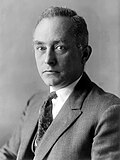
 United Kingdom of Great Britain and Northern Ireland
Explanation
In the very tiny world, things do not move by the rules we see every day. Max Born realized that the motion of electrons can be described best by talking about "probabilities." He used a set of numbers called a "wavefunction," which spreads out like water waves, to calculate where a particle is likely to be found. It is a bit like thinking about the chances of rolling a certain number on a die. Thanks to his idea, we can now build computer chips and many other modern devices.
Related Keywords
quantum mechanics
Quantum mechanics is the theory describing the motion and energy states of atoms, molecules, and electrons. It handles phenomena such as interference and tunnelling that classical mechanics cannot explain. The uncertainty principle forbids simultaneous precise knowledge of position and momentum. Mathematically it is built on wavefunctions and linear operators in Hilbert space. It forms the basis for nanotechnology and quantum information science.
wavefunction
The wavefunction is a complex-valued function that describes the state of a particle across space and time. Born interpreted its squared modulus as the probability of finding the particle. Its phase carries information that leads to interference and superposition. It is normalized and evolves according to the Schrödinger equation. Upon measurement it changes to a new wavefunction via projection.
Born rule
The Born rule interprets \(|\psi|^{2}\) as probability, providing outcome distributions for quantum measurements. This makes quantum theory testable against experiments. In many-body systems and quantum information it is generalized to projective measurements and POVMs. The derivation of the rule is debated, involving approaches such as environment-induced decoherence and deterministic hidden-variable theories. Practically it is essential for predicting photon detection probabilities and electron densities in semiconductors.
Schrödinger equation
The time-dependent Schrödinger equation, \(i\hbar\,\partial_t\psi=\hat{H}\psi\), governs the evolution of the wavefunction. Here \(\hat{H}\) is the Hamiltonian acting as the energy operator. Solutions can be superposed, producing quantum interference. In the time-independent form, eigenstates and energy eigenvalues are obtained. It is widely used to compute atomic spectra and chemical bonding.
uncertainty principle
Heisenberg’s relation \(\Delta x\,\Delta p\ge\hbar/2\) sets a limit on simultaneous knowledge of position and momentum. It arises from the dual wave-particle nature and the Fourier relationship of the wavefunction. Time-energy versions are discussed in quantum field theory and quantum optics. It is crucial for understanding tunnelling currents in semiconductors and laser cooling. The principle is also used when analyzing measurement errors and disturbances.
Hilbert space
Hilbert space is a complete vector space with an inner product in which quantum states are represented by vectors. Observables act as self-adjoint operators whose eigenvectors correspond to measurement outcomes. The notions of distance and angle allow geometric interpretation of probability amplitudes and interference. Infinite-dimensional Hilbert spaces handle continuous spectra. Born’s formalization led to later developments such as rigged Hilbert spaces and C*-algebraic formulations.