1955 Nobel Prize in Physics(2)
Reason for Award
for his precision determination of the magnetic moment of the electron
Laureates
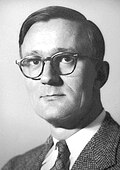
 United States of America
Explanation
An electron is an extremely small particle but it behaves like a tiny bar magnet, just like a compass needle. Mr. Kusch invented a new experimental method to measure how strong this miniature magnet is. The measurement was like watching a delicate needle wobble under a magnifying glass—extremely precise work. His results showed that earlier theories were not completely correct and encouraged scientists to perform more accurate calculations. Thanks to his work we now understand electrons and light much more deeply.
Related Keywords
electron magnetic moment
A measure of how strongly an electron behaves like a tiny magnet. It is given by the product of the Bohr magneton μB and the g-factor, and its precise determination is essential for testing quantum theory.
Bohr magneton
A natural unit for atomic magnetic moments defined as eħ/2m_e. It serves as the reference for evaluating the magnetic effects of an electron’s spin and orbital motion.
g-factor
The proportionality constant between magnetic moment and angular momentum. For a free electron it is close to 2, with tiny quantum corrections; measuring its small deviation provides clues to new physics.
atomic beam magnetic resonance
A technique in which a beam of neutral atoms is exposed to an RF field to flip spins and measure resonance frequencies. Developed by Rabi and refined by Kusch, it is the precursor to NMR and atomic-clock technology.
Zeeman effect
The splitting of atomic energy levels in an external magnetic field. Measuring the splitting width provides a direct means of determining magnetic moments and g-factors.
anomalous magnetic moment
The small deviation of the g-factor from 2, expressed as Δg = g−2, chiefly caused by radiative corrections from quantum vacuum fluctuations. It is employed in precision tests of QED and the Standard Model and in searches for new particles.