1960 Nobel Prize in Physics
Reason for Award
for the invention of the bubble chamber, Phys. Rev. 87 (1952) 665-665
Laureates
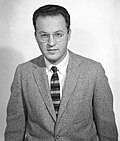
 United States of America
Explanation
Imagine the tiny bubbles that appear in a glass of soda. Mr. Glaser used a similar idea to show the invisible paths of tiny particles (called elementary particles) by turning those paths into strings of bubbles. His device is the "bubble chamber." When a particle passes through, it leaves a bubbly trail in the liquid, and taking a photograph of the trail shows where it went. It is like finding a hidden friend by following a trail of bubbles.
Related Keywords
bubble chamber
A detector that visualizes the paths of charged particles as bubbles in a superheated liquid. The high density of the liquid allows precise recording of even short-range particles. When placed in a magnetic field the bubble tracks curve, enabling momentum and charge measurements. From the 1950s to the 1970s it was the workhorse of high-energy physics, underpinning discoveries of many new particles and resonances. It paved the way for modern detectors such as silicon trackers.
cloud chamber
A device that renders the passage of charged particles visible as lines of condensation droplets in supersaturated vapor. It is the precursor to the bubble chamber and, because of its lower density, is well suited for observing long-range tracks. Prominent in cosmic-ray studies of the 1920s, it contributed to discoveries such as the positron. Glaser developed the bubble chamber to overcome limitations of the cloud chamber by using a denser medium. Comparative studies of the two detectors spurred advances in detector physics.
superheated liquid
A metastable state in which a liquid is held slightly above its boiling point but does not boil in the absence of perturbations. When a charged particle passes through, localized boiling initiates and bubbles form. The bubble chamber exploits this phenomenon to visualize particle trajectories. The degree of superheat and pressure cycling control the detector’s sensitivity and spatial resolution. Thermodynamics and nucleation theory underpin its design.
high-energy accelerator
A machine that accelerates particles to near the speed of light and collides them to study new particles and reactions. Bubble chambers were placed in the beamlines of such accelerators and recorded the detailed tracks of collision products. Examples include the Chicago Bevatron and CERN’s Proton Synchrotron. The accelerator-bubble-chamber combination laid much of the experimental foundation leading up to the Standard Model.
particle physics
The branch of physics that investigates the fundamental constituents of matter and the forces between them. From the 1950s onward, the bubble chamber accelerated research in hadron physics and weak interactions before the quark model era. It was central to direct observations of neutrino reactions and measurements of strange-particle decay patterns. It passed on data-taking techniques to successor detectors, and its legacy continues in modern large-scale experiments such as the LHC.