1964 Nobel Prize in Physics
Reason for Award
for fundamental work in the field of quantum electronics, which has led to the construction of oscillators and amplifiers based on the maser-laser principle
Laureates
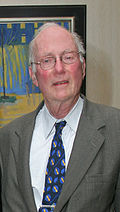
 United States of America
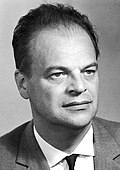
 Soviet Union
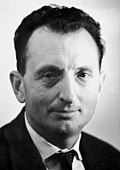
Soviet Union
Explanation
The red beam you see in barcode scanners or DVD players is a laser, a very straight and strong light. To create a laser or a maser (the microwave version of a laser) you need a way to make the light waves from atoms line up perfectly. Mr. Townes, Mr. Basov and Mr. Prokhorov figured out how to do that and built real machines that can amplify light or microwaves. Thanks to their invention we enjoy useful tools such as fast internet links and medical devices.
Related Keywords
quantum electronics
The discipline that controls electrons and photons through quantum mechanics to provide functions such as oscillation, amplification and detection. It emerged with the invention of masers and lasers and later expanded to semiconductor lasers, quantum computers and many other technologies.
maser
An abbreviation of Microwave Amplification by Stimulated Emission of Radiation. It amplifies and oscillates microwaves via stimulated emission and is vital in atomic clocks and low-noise amplifiers for deep-space communication; it is essentially the microwave analogue of a laser.
laser
An acronym for Light Amplification by Stimulated Emission of Radiation, a high-brightness, highly coherent light source spanning ultraviolet to infrared wavelengths. It underpins telecommunications, medicine, materials processing and precision measurement.
population inversion
A nonequilibrium state in which more particles occupy an excited level than a lower level, so stimulated emission exceeds absorption and provides gain. It is the indispensable condition for maser and laser operation and is achieved by pumping schemes.
coherence
A measure of how well the phase and frequency of waves are aligned. Laser light exhibits high spatial and temporal coherence, an essential property for interferometry, holography and quantum communication.
optical resonator
A structure of two mirrors or dielectric boundaries that allows light to bounce back and forth, amplifying it and selecting modes. Mirror reflectivity and cavity length set output power and linewidth, and stability analysis is central to laser design.
microwave amplification
The technology of strengthening signals in the noise-dominated microwave band. Maser amplifiers achieve extremely low noise figures and are used as front-end amplifiers in radio astronomy and superconducting-qubit readout.