1975 Nobel Prize in Physics
Reason for Award
for the discovery of the connection between collective motion and particle motion in atomic nuclei and the development of the theory of the structure of the atomic nucleus based on this connection
Laureates
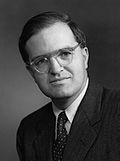
 Denmark

Denmark

 United States of America
Explanation
Inside every atom there is a tiny “atomic nucleus.” It is like a very small ball made of protons and neutrons packed together. The 1975 laureates discovered that the way each little particle moves and the way the whole nucleus shakes or spins are linked. Thanks to this finding, scientists can understand the nucleus and its energy much better.
Related Keywords
atomic nucleus
The tiny central region of matter composed of protons and neutrons. It carries nearly all atomic charge and mass; uncovering its structure is vital for energy applications and understanding cosmic evolution.
collective motion
Macroscopic degrees of freedom such as rotation and vibration produced by the coherent action of many nucleons. They leave clear fingerprints in level systematics and transition probabilities.
independent particle model
An approximation treating each nucleon as a single particle in an average potential. It explains shell structure and magic numbers but cannot by itself reproduce collective effects.
unified model
The Bohr–Mottelson framework that treats independent particle and collective degrees of freedom together, providing unified predictions for rotational bands, vibrational states, and many other nuclear phenomena.
quadrupole deformation
A departure from spherical shape where the nucleus becomes rugby-ball-like or pancake-like; larger deformation parameter β yields clearer rotational spectra.
rotational band
A series of energy levels in a deformed nucleus excited by increasing angular momentum, typically following the relation E∝J(J+1).
vibrational excitation
Collective states where an almost spherical nucleus expands and contracts while keeping symmetry; the first 2+ level is a classic example, akin to a nuclear rattle.
shell model
An energy-level structure in the nucleus organized by quantum numbers, analogous to electron shells in atoms; it explains magic numbers and spin-parity assignments.
nuclear spectroscopy
A set of techniques measuring gamma rays or particles emitted from excited states to determine level energies and transition rates; essential for testing the unified model.
pairing interaction
A Cooper-pair–like effect where like nucleons couple with opposite spins; sharing the same mathematical structure as superconductivity, it influences odd-even mass differences and nuclear moments of inertia.