1981 Nobel Prize in Physics(1)
Reason for Award
for their contribution to the development of laser spectroscopy (Phys. Rev. 104 (1956) 324-327, Phys. Rev. 127 (1962) 1918-1939)
Laureates

 United States of America
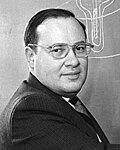
United States of America
Explanation
Every substance around us has its own special 'fingerprint' of light. When a very narrow and strong beam called a laser shines on it, that fingerprint can be read very clearly. Mr. Bloembergen and Mr. Schawlow improved the way to read fingerprints with laser light. This technique is called laser spectroscopy. Thanks to it we can measure even tiny amounts of gas in the air and learn what distant stars are made of. It is like an optical magnifying glass that also helps doctors and environmental scientists.
Related Keywords
laser
A source of coherent light produced by stimulated emission. Its extremely narrow and intense beam makes it ideal for precision spectroscopy.
spectroscopy
A family of methods that analyzes how matter interacts with electromagnetic radiation to reveal composition and structure. Laser-based versions achieve far higher resolution than conventional prism or grating techniques.
nonlinear optics
The study of phenomena in which intense light modifies a medium’s optical properties, enabling frequency doubling, mixing and new wavelengths. Such processes are essential for tunable laser spectroscopy.
saturated absorption spectroscopy
A technique that uses two counter-propagating laser beams to cancel Doppler broadening and reveal extremely sharp absorption lines. It provides reference frequencies for atomic clocks.
Doppler broadening
The widening of spectral lines caused by the thermal motion of atoms or molecules. Removing or correcting it is vital for high-precision spectroscopy.
frequency stabilization
Methods that keep a laser’s frequency from drifting by locking it to a reference cavity or atomic transition. Stability better than 10^-12 is required in modern metrology.
Raman scattering
Inelastic scattering in which photons exchange vibrational energy with molecules, shifting their wavelength. It yields detailed information on molecular structure and bonding.