1984 Nobel Prize in Physics
Reason for Award
for their decisive contributions to the large project that led to the discovery of the W and Z particles, mediators of the weak interaction
Laureates
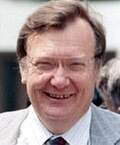
 Italy
Italy
 Netherlands
Explanation
The matter around us is made of very tiny particles. These particles pull or push each other through four kinds of forces, and one of them is called the “weak force.” Carlo Rubbia and Simon van der Meer helped find two special particles, the W boson and the Z boson, which carry this weak force. Detecting them was like finding an invisible insect with a magnifying glass, only far more difficult. Thanks to their work, we now understand better how nature is built at the smallest scales.
Related Keywords
W boson
A charged gauge boson that mediates the weak interaction. With a mass of about 80 GeV/c², it enables flavour changes between leptons and quarks in processes such as beta decay.
Z boson
The neutral carrier of the weak neutral current. It has a mass near 91 GeV/c² and appears in neutrino scattering and electron–positron pair production.
weak interaction
One of the four fundamental forces of nature. It governs radioactive decay and solar fusion processes and is mediated by the W and Z bosons.
stochastic cooling
A technique that reduces the energy spread and spatial extent of a particle beam via feedback from detected fluctuations. Essential for producing high-brightness antiproton beams.
electroweak theory
Also known as the Glashow–Weinberg–Salam model, it unifies weak and electromagnetic interactions under SU(2)×U(1) symmetry and predicted the existence of the W and Z bosons.
CERN Super Proton Synchrotron (SPS)
A circular accelerator near Geneva with a circumference of about 7 km. After modification, it became the world’s first high-energy p–p̄ collider and hosted the W and Z discovery experiments.
antiproton
The antiparticle of the proton, carrying negative charge. Colliding protons with antiprotons provides high center-of-mass energy.
Standard Model
The prevailing theory describing fundamental particles and their interactions. It includes electroweak unification and quantum chromodynamics; the discovery of W and Z was a key confirmation.
particle accelerator
A device that produces high-energy particle beams to probe the fundamental structure of matter. It also has applications in medicine and materials science.
UA1 detector
A 4π multi-purpose detector designed to detect the W and Z bosons, featuring tracking, calorimetry, and muon systems.