1987 Nobel Prize in Physics
Reason for Award
for their important breakthrough in the discovery of superconductivity in ceramic materials (Zeitschrift für Physik B 64 (1986) 189–193, Bednorz & Müller)
Laureates
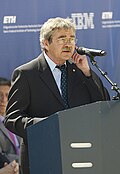
 West Germany
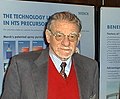
 Switzerland
Explanation
Normally, when electricity flows, the wire gets warm and some energy is lost. In a state called “superconductivity,” electricity flows with no resistance at all, so nothing heats up. Mr. Bednorz and Mr. Müller discovered that ceramic material—something like the clay of a teacup—can become superconducting. Earlier superconductors only worked in extremely cold conditions, but their material works at a higher temperature. Thanks to this finding, ideas such as trains that float and super-strong magnets came much closer to reality.
Related Keywords
superconductivity
A phenomenon where a material exhibits zero electrical resistance and expels magnetic flux (Meissner effect) below a critical temperature. It enables loss-free power transmission and powerful magnets, first discovered in mercury by Kamerlingh Onnes in 1911.
high-temperature superconductivity
Refers to materials that become superconducting at temperatures near or above liquid nitrogen (77 K). Since the 1986 cuprate discovery, bismuth-based, iron-based, and other compounds have been reported, and the pairing mechanism remains an active research topic.
perovskite oxide
A class of oxides with the ABO3 crystal structure. Cuprate superconductors belong to the layered perovskite family; lattice distortions and doping enable wide tuning of electronic and magnetic properties, making the structure central to research.
Cooper pair
A bound state of two electrons in the superconducting phase. Mediated by phonons or spin fluctuations, the attractive interaction overcomes Coulomb repulsion, allowing the paired electrons to condense and carry current without resistance.
critical temperature
The temperature at which a material transitions into the superconducting state. A higher Tc lowers cooling costs, making applications more feasible. After the cuprate discovery, Tc values surpassed 90 K, enabling liquid-nitrogen cooling.
Meissner effect
The expulsion of magnetic flux from a superconductor, producing strong diamagnetism. It enables magnetic levitation and ultra-low-friction bearings. Discovered by Meissner and Ochsenfeld in 1933.