1995 Nobel Prize in Physics(2)
Reason for Award
Pioneering experimental contributions to lepton physics (detection of the neutrino) Science 124 (1956) 103–104
Laureates
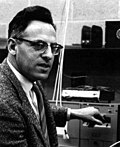
 United States of America
Explanation
Inside the Sun and nuclear reactors, huge numbers of invisible particles called neutrinos are produced. Neutrinos pass through almost everything like ghosts, so they are very hard to catch. Frederick Reines placed special detectors next to a reactor and looked for tiny flashes of light when neutrinos struck a liquid similar to water. By catching those faint flashes, he observed real neutrinos for the first time. This success opened a new way of looking at the universe.
Related Keywords
neutrino
A fundamental particle with zero electric charge, very small mass, and interactions only via the weak force. Produced abundantly in cosmic backgrounds and stellar interiors, its high penetrating power allows it to carry internal information, earning it the title of a cosmic ‘messenger’.
inverse beta decay
The process in which an electron antineutrino collides with a proton to create a positron and a neutron. With a threshold of 1.8 MeV, it is the most basic reaction used for neutrino detection in many experiments.
coincidence measurement
A technique that registers multiple signals within defined time or spatial windows to greatly reduce background. In Reines’ experiment, detecting prompt and delayed γ-rays in coincidence ensured reliable neutrino identification.
photomultiplier tube
A vacuum tube that converts faint light into amplified electrical signals. As the core device for detecting scintillation and Cherenkov light, it is indispensable in neutrino and dark-matter experiments.
reactor neutrino
A flux of electron antineutrinos produced by β-decays following nuclear fission. With energies of a few MeV and controllable intensity, reactor neutrinos serve for detector calibration and precise oscillation parameter measurements.
neutrino oscillation
A quantum phenomenon in which neutrinos of different flavors transform into one another while propagating. It provides direct evidence that neutrinos have mass, and Reines’ detection techniques were later adapted for oscillation experiments.
Cherenkov radiation
The bluish light emitted when a charged particle travels through a medium faster than light can in that medium. It is used in large water or ice neutrino detectors to measure particle direction and energy.
Savannah River reactor
A nuclear facility in South Carolina, USA, historically significant as the site where Reines and Cowan achieved the world’s first neutrino detection.