1996 Nobel Prize in Physics
Reason for Award
for their discovery of superfluidity in helium-3 (Phys. Rev. Lett. 28, 885–888 (1972); Phys. Rev. Lett. 29, 920–923 (1972); Phys. Rev. A 8, 1633–1637 (1973))
Laureates
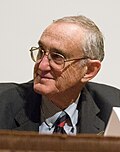
 United States of America
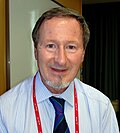
United States of America
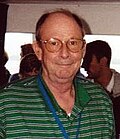
United States of America
Explanation
When helium gas is cooled down, it turns into a liquid. If you cool one special kind called helium-3 to about −270 °C, the liquid suddenly behaves in a very strange way. It can spin around a cup forever and even creep through tiny cracks and spill out. This state is called “superfluidity,” meaning the liquid flows with almost zero friction. Mr. Lee, Mr. Osheroff and Mr. Richardson discovered this in a college basement laboratory. By carefully listening to small changes in their equipment, they uncovered a new world. Their work shows how mysterious quantum rules appear when matter becomes extremely cold.
Related Keywords
superfluidity
Superfluidity is a quantum phenomenon in which a liquid loses all internal friction and flows without viscosity. The liquid can climb container walls or whirl indefinitely in the same spot. It arises because, at very low temperatures, the wave nature of the particles overlaps and forms a macroscopic quantum state. Superfluidity in helium-4 originates from Bose statistics, whereas in helium-3 it results from fermions forming Cooper pairs by a different mechanism. The concept plays a crucial role in studies ranging from superconductivity to the internal flows of neutron stars.
helium-3
Helium-3 is a rare isotope composed of two protons and one neutron, giving it mass number three. It is produced in the Big Bang and in solar wind, and on Earth it exists only in trace amounts in natural gas deposits. Because the nucleus has odd mass number, liquid helium-3 obeys Fermi statistics and normally behaves as a Fermi liquid. At ultralow temperatures it forms Cooper pairs and becomes superfluid, displaying unique spin-triplet p-wave phases. The isotope is also discussed as a clean nuclear-fusion fuel and as a medium for quantum simulation.
Fermi liquid
A Fermi liquid is a theoretical framework describing interacting fermions whose low-energy excitations behave as long-lived quasiparticles, applicable to normal metals and liquid helium-3. Landau organized it by treating energy, momentum and spin as smoothly varying functions of the quasiparticle distribution. It predicts properties such as linear-in-temperature specific heat and nearly constant magnetic susceptibility, matching experiments. The normal phase of helium-3 just above the superfluid transition is a textbook Fermi liquid, and precision measurements there have tested the theory. In high-temperature superconductors and other strongly correlated systems, the breakdown of Fermi-liquid behavior is an active research topic.
Cooper pair
A Cooper pair is a bound state of two fermions that, taken together, behave as a boson. In metals, electrons experience a weak effective attraction via lattice vibrations (phonons) and pair up as the temperature falls. When the pairs overlap and condense into a single quantum state, superconductivity occurs with zero electrical resistance. Helium-3 atoms, possessing nuclear spin 1/2, form spin-triplet p-wave Cooper pairs that give rise to superfluidity. The Cooper-pair concept bridges quantum statistics and condensation phenomena, playing a central role in both superconductors and superfluids.
quantized vortex
In superfluids and superconductors, the circulation around a vortex takes only discrete values proportional to Planck’s constant; such vortices are called quantized vortices. When a frictionless fluid rotates, it does not form a continuous swirl but rather thin filament-like vortex lines. Quantized vortices in helium-3 have intricate internal structures where spin and orbital degrees of freedom intertwine, and fermionic quasiparticles localize in the core. Observing and manipulating these vortices provides a powerful probe of the superfluid’s internal symmetry and topology. Recently, applications have been explored in quantum turbulence studies and even in proposals for topological quantum computation.