2006 Nobel Prize in Physics
Reason for Award
for the discovery of the black-body form and anisotropy of the cosmic microwave background radiation (Astrophys. J. 420 (1994) 439-444; Astrophys. J. 464 (1996) L1-L4)
Laureates
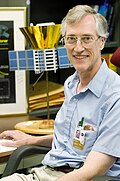
 United States of America

United States of America
Explanation
No matter where we look in the sky, very faint microwaves arrive at Earth. They are the cooled-down light from the hot, glowing Universe about 13.8 billion years ago. Using the satellite COBE, Dr. Mather and Dr. Smoot showed that this glow follows a perfect “black-body” curve and that its temperature changes ever so slightly from place to place. The differences are only about one ten-thousandth of a degree, but they acted as seeds for stars and galaxies. Thanks to their work, we can read the storybook of the Universe’s early days.
Related Keywords
cosmic microwave background radiation
The electromagnetic radiation released when the Universe became neutral about 380 000 years after the Big Bang. Now cooled to about 2.7 K microwaves that fill the entire sky, it preserves a fossil record of the early cosmos.
black-body radiation
Radiation with an ideal spectrum determined solely by temperature. The fact that the CMB follows this distribution is a key test of Big-Bang cosmology.
anisotropy
Small directional variations in intensity or temperature. CMB anisotropies trace primordial density fluctuations that seeded galaxy formation.
COBE satellite
NASA’s 1989 Cosmic Background Explorer satellite, whose instruments FIRAS and DMR made the first precise measurements of the CMB spectrum and anisotropy.
Big Bang
The standard cosmological model in which the Universe expanded from an extremely hot, dense state. The existence and properties of the CMB are critical evidence for this model.
cosmic inflation
The hypothesis that the early Universe underwent exponential expansion for a brief moment, stretching quantum fluctuations to macroscopic scales and explaining the origin of CMB anisotropies.
gravitational instability
The process by which slightly overdense regions grow via gravity, eventually forming stars and galaxies. CMB temperature fluctuations represent its initial conditions.
cold dark matter (CDM)
Non-luminous, slow-moving particles thought to dominate the mass of the Universe. The CMB power spectrum indicates that most cosmic matter density is in CDM.