2015 Nobel Prize in Physics
Reason for Award
for the discovery of neutrino oscillations, which shows that neutrinos have mass (Nucl. Phys. B-Proc. Suppl. 77 (1999) 123 〈Kajita〉, 43 〈McDonald〉)
Laureates
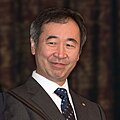
 Japan
Japan

 Canada
Explanation
1. Neutrinos are tiny, invisible particles. 2. Billions of them pass through Earth and our bodies every second. 3. Dr. Kajita and Dr. McDonald found that a neutrino can change its kind while flying. 4. This change is called “oscillation.” 5. To oscillate, a neutrino must have a little weight, or mass. 6. Scientists once thought neutrinos were weightless. 7. Their discovery made scientists rewrite textbooks. 8. It also helps us learn how the universe and stars work.
Related Keywords
neutrino
1. A neutral, very light elementary particle interacting only via the weak force. 2. Exists in three flavors: electron, muon, and tau. 3. Second most abundant particle in the universe after photons, produced in the Big Bang and inside stars. 4. Rarely interacts with matter, making detection difficult yet invaluable for probing Earth’s interior and supernovae. 5. Oscillations revealing their mass provide clues to physics beyond the Standard Model.
neutrino oscillation
1. A quantum process whereby a neutrino converts probabilistically into another flavor while propagating. 2. Arises because mass eigenstates differ from flavor eigenstates. 3. The oscillation length and amplitude depend on Δm² and mixing angles θ. 4. Experimentally seen as energy- and distance-dependent variations in detected event rates. 5. Its existence implies neutrinos have non-zero mass.
mass eigenstate
1. A quantum state with a definite mass value. 2. For neutrinos, the states are |ν₁⟩, |ν₂⟩, and |ν₃⟩. 3. Flavor states are linear combinations of these mass states. 4. Mass-squared differences Δm² set the oscillation frequency. 5. Determining absolute masses remains an open experimental challenge.
muon neutrino
1. The second-generation neutrino partnered with the μ⁺/μ⁻ lepton. 2. Abundantly produced in atmospheric showers and accelerator beams. 3. Its deficit in Super-Kamiokande provided key oscillation evidence. 4. Shows pronounced L/E-dependent disappearance in the 1–10 GeV range. 5. Studied in detail by long-baseline experiments like T2K and NOvA.
tau neutrino
1. The third-generation neutrino paired with the τ lepton. 2. Hard to detect directly, making it pivotal as an oscillation daughter. 3. OPERA provided the first ντ appearance observation. 4. Super-Kamiokande statistically identified a ντ component. 5. ντ detection is essential to verify flavor completeness in oscillations.
solar neutrino problem
1. Since the 1960s, observed solar neutrinos were only 1/3–1/2 of predictions. 2. The discrepancy was first attributed to solar model or detector errors. 3. Flavor conversion hypothesis emerged. 4. SNO’s NC/CC measurements resolved it, showing total flux matched theory. 5. The solution strongly supported the neutrino oscillation model.
Super-Kamiokande
1. A 50-kton water Cherenkov detector 1,000 m underground in Kamioka, Japan. 2. Observes atmospheric, solar, accelerator, and supernova neutrinos. 3. Reported muon-neutrino disappearance in 1998, suggesting oscillations. 4. Features high-sensitivity PMTs and stringent water purity control. 5. An upgraded successor, Hyper-Kamiokande, is under construction.
Sudbury Neutrino Observatory
1. Located 2 km underground in an Ontario nickel mine, Canada. 2. Uses 1 kton of heavy water to measure NC, CC, and ES reactions simultaneously. 3. In 2001 proved electron-flavor deficit while total flux matched predictions. 4. Provided the decisive solution to the solar neutrino problem. 5. Its successor SNO+ targets 0νββ searches and low-energy neutrino studies.