2016 Nobel Prize in Physics
Reason for Award
for theoretical discoveries of topological phase transitions and topological phases of matter
Laureates

 United Kingdom of Great Britain and Northern Ireland,
  United States of America

United Kingdom of Great Britain and Northern Ireland,  Slovenia
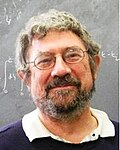
United Kingdom of Great Britain and Northern Ireland, United States of America
Explanation
Water turns to ice when it gets cold, but in ultrathin materials even stranger changes happen. The laureates discovered how the properties of matter suddenly shift in layers thinner than paper. They used the idea of topology, which counts holes like those in a doughnut, to explain the effect. When the temperature rises a little, tiny vortex pairs split apart and signal a phase transition. Understanding this surprise helps us design new conductors and perhaps the computers of the future.
Related Keywords
topology
Topology is the branch of mathematics that studies properties preserved when an object is stretched or bent but not torn. A doughnut and a coffee mug both have one hole and therefore belong to the same topological class, despite their different shapes. In condensed-matter physics, quantities such as the winding of electronic bands or the number of vortices play the role of topological invariants. These invariants are robust against small perturbations, protecting certain physical properties of a material. Consequently, topology provides the key explanation for the precise quantization seen in the quantum Hall effect and topological insulators.
topological phase
A topological phase is a quantum state of matter protected by an energy gap and classified by topological invariants. Unlike conventional phases, it is not characterized by an order parameter or symmetry breaking. While the bulk may be insulating, conducting edge or surface states emerge that carry charge or spin with little scattering. Because of their robustness against disorder and geometric deformations, such phases are attractive for device applications. Combining them with superconductivity, magnetism, or photonics is an active field, and they are being explored as building blocks for quantum computers.
Berezinskii–Kosterlitz–Thouless transition
The BKT transition is an unusual phase transition occurring in two-dimensional XY systems and thin superfluid films. At low temperatures vortex–antivortex pairs are bound and the superfluid density is finite, but above the critical temperature the pairs unbind and order is lost. At the transition, quantities change exponentially and the transition is governed by the behavior of topological defects rather than by a discontinuity in thermodynamic variables. Experiments on helium films and Josephson-junction arrays have verified the transition and the universality of its critical exponents. The BKT theory, combining renormalization-group analysis with the concept of topological defects, is widely cited as a textbook example.
quantum Hall effect
The quantum Hall effect occurs when a two-dimensional electron gas at very low temperature and high magnetic field shows a Hall resistance quantized in exact integer (or fractional) multiples of h/e^2. In the integer case, the number equals the Chern number, a topological invariant of the electronic bands. The precision, reproducible to parts per billion, makes the effect the international resistance standard. While the bulk is insulating, chiral edge channels carry current with virtually no back-scattering. Understanding this phenomenon laid the groundwork for the field of topological materials and inspired models such as Haldane’s and modern spintronics devices.
topological insulator
A topological insulator is a material whose interior is insulating while its surface or edges conduct like a metal. Surface states possess a fixed relationship between spin and momentum, protecting them against back-scattering. As long as certain symmetries, such as time-reversal symmetry, are preserved, the edge states remain robust against disorder. They have been observed experimentally in bismuth-based alloys and HgTe quantum wells, where angle-resolved photoemission reveals Dirac cones. Potential applications include low-power electronic devices and platforms for topological quantum computation.