2018 Nobel Prize in Physics(2)
Reason for Award
for the development of a method for generating high-intensity, ultra-short laser pulses
Laureates
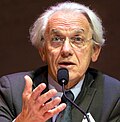
 France

 Canada
Explanation
If a laser can give off very strong light for a very short time, it can cut and measure tiny things without breaking them. Gérard Mourou and Donna Strickland made this possible by first stretching a weak light pulse, then amplifying it, and finally squeezing it back to its original short length. Lasers built with this idea are used for eye-surgery on nearsighted patients and for making parts inside smartphones. Because the flash lasts only a million-billionth of a second, scientists can watch molecules move in slow motion. Many precision technologies that support our daily life rely on this invention.
Related Keywords
chirped-pulse amplification (CPA)
A technique in which a pulse is temporally stretched to lower its peak power, safely amplified, and then recompressed. It avoids material damage while enabling petawatt-level output. The stretcher and compressor must be designed to provide mirror-image dispersion characteristics. Virtually all modern high-intensity lasers rely on CPA. It plays a central role in fields ranging from attosecond science to laser fusion.
femtosecond laser
A laser that delivers pulses roughly 10⁻¹⁵ seconds long. Because energy is deposited faster than heat can diffuse, it minimizes burrs and heat-affected zones in micromachining. It serves as a stroboscopic tool for observing ultrafast processes such as chemical reactions and phase transitions. Industrial applications include vision-correction surgery and fabrication of medical stents. Increasing repetition rate and average power are current technical challenges.
LASIK surgery
An ophthalmic procedure that corrects vision by making precise cuts in the cornea with a femtosecond laser. The ultrashort pulse minimizes thermal effects, preventing tissue charring or cracking. By fine-tuning laser intensity and scan patterns, surgeons sculpt patient-specific corneal shapes. Postoperative recovery is rapid, and tens of millions of procedures have been performed worldwide. It stands as a flagship medical application of CPA technology.
high-order harmonic generation
A nonlinear process in which an intense laser pulse drives electrons in gases or solids, causing them to emit light at frequencies tens to hundreds of times higher than the input. It is the foundation for attosecond pulse sources. Conversion efficiency depends sensitively on medium density and phase-matching conditions. Coherent light up to the soft X-ray band enables time-resolved studies of electron spins and chemical bonds. Plasma-mirror techniques are being explored to extend the spectrum into the extreme ultraviolet.
laser-driven plasma acceleration
A method where an ultra-short pulse forms a wakefield inside plasma, accelerating electrons or ions to GeV energies. It provides acceleration gradients (> 100 GV/m) orders of magnitude higher than conventional RF accelerators. Because the setup can be tabletop-sized, it promises new generations of X-ray sources and cancer-therapy beams. Controlling beam emittance and energy spread remains a technical challenge. Advances in CPA lasers directly influence progress in this accelerator field.
carrier-envelope phase (CEP)
A quantity describing the offset between the optical field oscillation and the pulse envelope in an ultra-short pulse. It strongly influences outcomes in attosecond pulse generation and strong-field physics. Measured with an f-2f interferometer and stabilized via electronic feedback. Long-term CPA system stability requires suppressing fluctuations below the milliradian level. CEP is a critical parameter in quantum control and precision metrology.