2022 Nobel Prize in Physics
Reason for Award
for experiments with entangled photons, establishing the violation of Bell inequalities and pioneering quantum information science
Laureates

 France

 United States of America
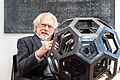
 Austria
Explanation
The light we see is made of many tiny particles called photons. The laureates studied a strange effect called “quantum entanglement,” where two photons act as if they are linked by an invisible thread. When you look at one photon, the other decides its state instantly, even if it is far away. It’s like throwing a soccer ball to a friend and, at the same moment, a distant ball changes color. Understanding this helps us build super-safe communication lines and brand-new kinds of computers.
Related Keywords
quantum entanglement
Quantum entanglement is a phenomenon in which several particles share a joint state, so that the outcome of measuring each particle cannot be fully described without reference to the others. Prior to measurement, the physical quantities of the individual particles are undefined; measurement instantaneously defines correlated values. Because coherence is maintained despite spatial separation, entanglement is the source of non-local correlations. It is an indispensable resource for the parallelism of quantum computers, the security of quantum communication, and the sensitivity boost in quantum sensing. Recently, high-fidelity entanglement has been achieved not only with photons but also in trapped ions and superconducting qubits.
Bell inequalities
Bell inequalities provide statistical upper bounds that any local-realistic hidden-variable theory must satisfy. By comparing correlations of measurement outcomes under four or more detector settings, one examines whether the metric S exceeds 2, thus testing consistency with quantum mechanics. Observing a violation rules out hidden-variable models and supports non-locality. Several variants, such as CHSH or CH formulations, are tailored to different experimental constraints. Extensions to multipartite and continuous-variable systems are actively studied both theoretically and experimentally.
photon polarization
Photon polarization, defined by the oscillation direction of the electric field, is an internal degree of freedom analogous to classical transverse waves. In quantum mechanics any state is a superposition of linear and circular bases and can be visualized on a Poincaré sphere isomorphic to Pauli matrices. It can be easily manipulated and measured with polarizers and wave plates, making it ideal for entangled-pair generation and quantum key distribution. High detector efficiency and room-temperature operation render polarization the carrier of choice for large-scale quantum networks. Coupling with nanophotonics enables on-chip quantum optics applications.
quantum teleportation
Quantum teleportation transfers an unknown quantum state to a distant location without physically moving the carrier. The sender performs a Bell-state measurement on the state and half of an entangled pair, then transmits the result over a classical channel. The receiver applies a unitary operation conditioned on that result, reconstructing the original state. Because the state at the source is destroyed by the measurement, the protocol does not violate the no-cloning theorem. Teleportation is a cornerstone for quantum repeaters, distributed quantum computing, and the envisioned quantum internet.
quantum key distribution
Quantum key distribution (QKD) enables two parties to share an information-theoretically secure cryptographic key by exploiting quantum mechanics. Because measurement disturbs quantum states, any eavesdropper introduces detectable errors. Protocols such as BB84 and E91 exist; the latter uses entangled photons and Bell-test violations to guarantee security. Satellite links and metropolitan fibre networks now support QKD over hundreds of kilometres. As future quantum computers threaten classical cryptosystems, QKD offers a hardware-based, post-quantum secure communication method.
local realism
Local realism is the philosophical stance that physical properties exist with definite values prior to measurement and that interactions propagate no faster than light. While intuitive in classical physics, violations of Bell inequalities conflict with this view. Quantum mechanics attributes state definiteness to the act of measurement and allows non-local correlations. Experiments indicate that local realism is not a fundamental principle of nature. This forces reconsideration of causality and information transfer and fuels the development of quantum information theory.
hidden-variable theories
Hidden-variable theories attempt to explain quantum-mechanical probabilities by underlying deterministic parameters. They are broadly categorized into non-local models like Bohmian mechanics and local models targeted by Bell inequalities. Local hidden variables have been ruled out experimentally, whereas some non-local formulations can reproduce quantum statistics. Advances in loophole-free tests, using many-body systems and cosmic randomness for setting choices, have further constrained hidden-variable space. Theoretical investigation continues, comparing Copenhagen, many-worlds, and other interpretations.
quantum information science
Quantum information science is an interdisciplinary field that studies acquisition, processing and transmission of information using quantum mechanics. Superposition and entanglement enable algorithms with exponential advantages over classical computation. The discipline pursues large-scale machines via quantum error correction and fault-tolerant architectures. In communications, quantum repeaters and a quantum internet aim at worldwide entanglement distribution. Quantum sensing exploits squeezed states to surpass classical measurement limits. Non-local correlations, experimentally verified in the awarded work, lie at the heart of all these developments.