1964 Nobel Prize in Physiology or Medicine
Reason for Award
for their discoveries concerning the mechanism and regulation of cholesterol and fatty acid metabolism
Laureates

 United States of America
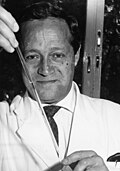
 West Germany
Explanation
Our bodies do not rely only on food for fat; they can make their own. Fat is important for storing energy and building cell walls. Dr. Bloch and Dr. Lynen carefully studied how the body makes these fats and how it avoids making too much. Thanks to their work, doctors can develop medicines that protect the heart and blood vessels. Their discoveries are the basis for keeping the cholesterol we often hear about at a safe level.
Related Keywords
cholesterol
A lipid with a steroid backbone that modulates membrane fluidity and serves as a precursor for bile acids and steroid hormones. It is produced in the liver and taken up from food. Although indispensable, excess levels promote atherosclerosis. Bloch and Lynen elucidated its biosynthetic route and regulation, providing the scientific basis for cholesterol management. Serum cholesterol is now a key indicator for cardiovascular risk assessment.
fatty acid biosynthesis
A reaction sequence that starts with acetyl-CoA, elongating the chain by two-carbon units donated by malonyl-CoA. It occurs in the cytosol via the multifunctional enzyme complex FAS. The resulting fatty acids are used for energy storage and membrane phospholipids. Lynen clarified FAS multifunctionality and regulation, showing how nutritional status affects lipid synthesis. The pathway remains central in obesity and diabetes research.
HMG-CoA reductase
The rate-limiting enzyme of cholesterol biosynthesis that reduces HMG-CoA to mevalonate in an NADPH-dependent reaction. When intracellular cholesterol is abundant, its transcription and degradation are enhanced, lowering activity. Short-term inhibition via phosphorylation is also known. Statins act as competitive inhibitors of this enzyme, lowering serum cholesterol. Bloch and Lynen’s work established the enzyme as a hub of metabolic control.
mevalonate pathway
A series of reactions converting acetyl-CoA to mevalonate and subsequently to isoprenoid precursors. It produces cholesterol as well as ubiquinone, dolichol, and prenylated proteins. The pathway is ancient and conserved across bacteria, yeast, and humans. Regulation at the rate-limiting HMG-CoA reductase node reverberates through overall metabolism. It is therefore a prime pharmaceutical target.
acetyl-CoA
A two-carbon carrier that links the citric acid cycle, lipid synthesis, ketone body formation, and more. It is produced in mitochondria and exported to the cytosol as citrate. Crucially, it is the starting substrate for both cholesterol and fatty acid synthesis. Acetyl-CoA also acts as a signaling molecule integrating energy and nutrient status. Bloch and Lynen’s work underscored its central role.
isotopic tracer
A technique that uses compounds labeled with radioactive or stable isotopes to track substance flow in the body. Bloch used 14C-acetate to determine the order of assembly in the cholesterol skeleton. By analyzing isotope distribution, a pathway can be defined without isolating every intermediate. The method has expanded into metabolomics combined with NMR and mass spectrometry. It remains indispensable for biosynthetic studies.
statin
A class of drugs that competitively inhibit HMG-CoA reductase, suppressing cholesterol synthesis. Developed in the 1970s based on foundational work by Lynen and others. They lower LDL cholesterol and dramatically reduce the risk of myocardial infarction and stroke. Side effects include myopathy and liver enzyme elevations, but clinical benefits are substantial. Statins are among the most widely prescribed medications worldwide.
enzyme regulation by phosphorylation
A mechanism in which ATP-dependent kinases phosphorylate enzymes, turning their activity up or down. In lipid metabolism, AMPK and PKA regulate HMG-CoA reductase and acetyl-CoA carboxylase, among others. It quickly converts nutritional or hormonal signals into changes in metabolic flux. Bloch and Lynen demonstrated that this short-term control acts in concert with long-term transcriptional regulation. The concept lies at the intersection of signaling and metabolism research.
SREBP
Sterol Regulatory Element-Binding Protein, a transcription factor that controls genes for cholesterol and fatty acid synthesis. When intracellular cholesterol drops, its precursor is cleaved in the Golgi, and the active form moves to the nucleus to induce gene expression. HMG-CoA reductase and FAS are among its targets. Identified later, SREBP confirmed Lynen’s idea of transcriptional regulation. Aberrant SREBP activation is a research focus in metabolic diseases and cancer.
lipid homeostasis
The mechanism that keeps the amount and types of lipids in the body within a narrow range. Synthesis, degradation, transport, storage, and signaling work together to adapt to energy demand and dietary changes. Bloch and Lynen showed that this equilibrium depends on both enzyme activity regulation and gene expression. When disrupted, it leads to dyslipidemia, obesity, fatty liver, and atherosclerosis. Lipid homeostasis is now a key integrative concept in life science.