2003 Nobel Prize
11
laureates
6
fields
2003
Nobel Prize
Nobel Prize in Physics
for pioneering contributions to the theory of superconductors and superfluids (Sov. Phys. JETP 5 (1957) 1174–1182; Zh. Eksp. Teor. Fiz. 32 (1957) 1442–1452; Zh. Eksp. Teor. Fiz. 20 (1950) 1064–1082; Phys. Rev. 140 (1965) A1869–A1888; Phys. Rev. 147 (1966) 119–130; Phys. Rev. Lett. 29 (1972) 1227–1230; Phys. Rev. Lett. 31 (1973) 352–355; Rev. Mod. Phys. 47 (1975) 331–414; Phys. Rev. Lett. 46 (1981) 211–214)
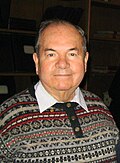
 United States of America,
 Russian Federation
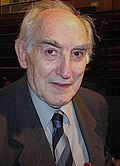
Russian Federation
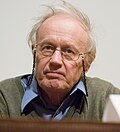
 United Kingdom of Great Britain and Northern Ireland,
United States of America
United Kingdom of Great Britain and Northern Ireland,
United States of America
Nobel Prize in Chemistry
Discovery of channels in cell membranes (identification of aquaporins)

United States of America
Discoveries concerning channels in cell membranes (structural and mechanistic studies of ion channels)

United States of America
Nobel Prize in Physiology or Medicine
for their discoveries concerning magnetic resonance imaging
United States of America

United Kingdom of Great Britain and Northern Ireland
Nobel Prize in Literature
for portraying, in innumerable guises, the surprising involvement of the outsider

 Australia,
 South Africa
Nobel Peace Prize
for her efforts for democracy and human rights, with particular focus on the struggle for the rights of women and children
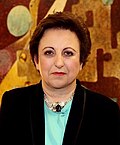
 Iran (Islamic Republic of)
Nobel Memorial Prize in Economic Sciences
for the development of statistical methods to analyze economic time series with time-varying volatility (ARCH) and common trends (cointegration)
United States of America
United Kingdom of Great Britain and Northern Ireland